 Language & Culture
Turkish Basics and Etiquette: Words, Customs and the Rules Worth Knowing
by Nate
Published 26 September 2026 · 4 min read · 👁 14 views
Quick summary
How to pronounce Turkish, the words you'll use every day, everyday courtesies, visiting mosques, Ramadan, public holidays — and the few rules (alcohol hours, smoking, tipping) that are law, not custom.
You can get by in Türkiye's big cities without Turkish, but a few words and a sense of everyday courtesies go a long way. This guide covers the basics — and separates custom (what people usually do) from the handful of things that are actually rules.
Reading Turkish
Turkish spelling is very regular — letters are pronounced far more consistently than in English — so learning a few will get you reading signs and menus aloud:
c — like the j in "jam" (cami, mosque: "jah-mee")
ç — like ch in "chair" (çay, tea)
ş — like sh in "ship" (şehir, city)
ğ — soft g: usually not pronounced as a consonant; it typically lengthens or blends with the vowels around it (dağ, mountain: roughly "daa")
ı (no dot) — a short vowel with no exact English equivalent; listen for it rather than matching it to an English sound
ö and ü — as in German
Words you'll use every day
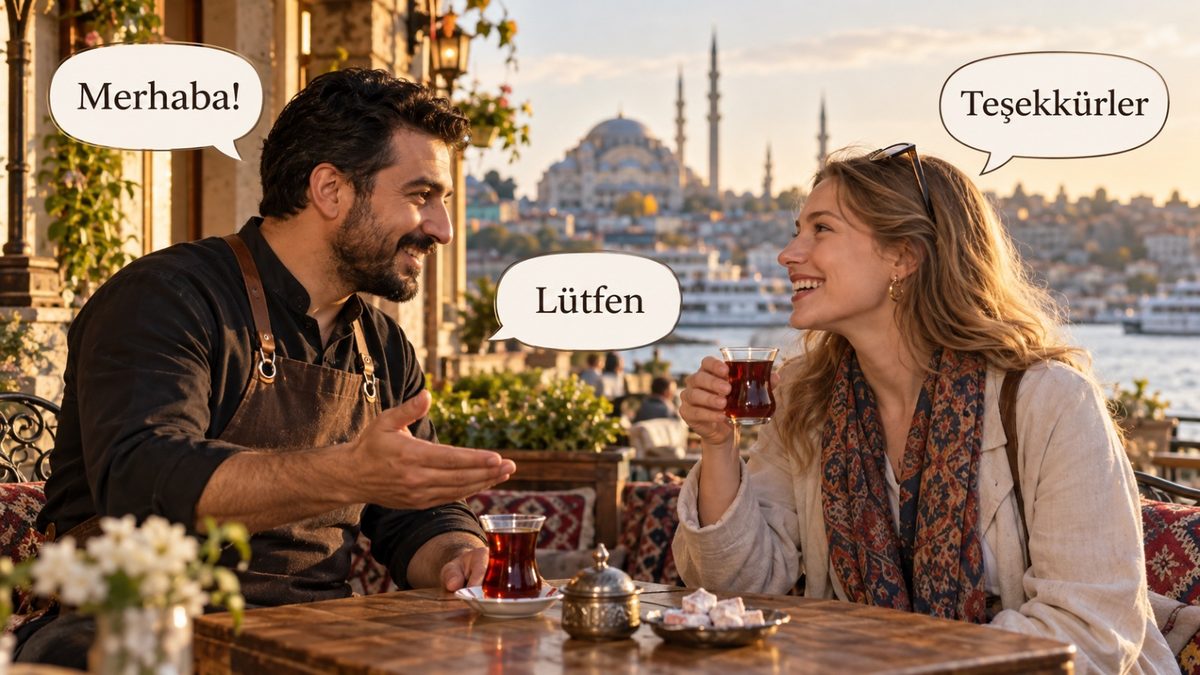
Merhaba — hello
Günaydın — good morning
Teşekkür ederim / Teşekkürler — thank you
Lütfen — please
Evet / Hayır — yes / no
Afedersiniz — excuse me (to get attention, or sorry)
Ne kadar? — how much?
Hesap, lütfen — the bill, please
Türkçe bilmiyorum — I don't speak Turkish
İngilizce biliyor musunuz? — do you speak English?
And a few phrases that do a lot of social work:
Kolay gelsin — "may it come easy", said to someone who is working
Afiyet olsun — enjoy your meal
Geçmiş olsun — get well soon / sorry that happened
Hayırlı olsun — congratulations on something new (a flat, a job)
Everyday courtesies
Names: people are often addressed by first name plus Bey (for a man) or Hanım (for a woman) — Ahmet Bey, Ayşe Hanım. It's polite and friendly at the same time.
Homes: it's common to take your shoes off at the door of someone's home; you may be offered slippers.
Tea: you'll often be offered çay — in homes, shops and offices. Accepting is a friendly gesture; declining politely is fine too.
"No" without words: a quick upward tilt of the head, sometimes with a click of the tongue, means no.
Visiting mosques
Most mosques welcome visitors outside prayer times. As a general guide:
Dress modestly: covered shoulders and knees; women cover their hair. Access rules — and whether scarves are lent at the entrance — vary by mosque.
Take your shoes off before you step onto the carpet.
Avoid prayer times, especially Friday midday prayers, keep your voice down, and don't walk in front of people praying.
Ramadan
During Ramadan many people fast from dawn to sunset. In the big cities most things keep running, but opening hours and services vary by neighbourhood and business, so check locally — and be considerate around people who are fasting. Expect crowds around sunset (iftar), when restaurants fill up and traffic gets heavy. Ramadan ends with a public holiday (Ramazan Bayramı).
Public holidays
Under Türkiye's public holidays law (Law No. 2429), these are public holidays:
1 January — New Year's Day
23 April — National Sovereignty and Children's Day
1 May — Labour and Solidarity Day
19 May — Commemoration of Atatürk, Youth and Sports Day
15 July — Democracy and National Unity Day
30 August — Victory Day
29 October — Republic Day (from 13:00 on 28 October)
Ramazan Bayramı (3.5 days) and Kurban Bayramı (4.5 days) — the two religious holidays, each beginning at 13:00 on the eve
The religious holidays follow the lunar calendar, so they move about 11 days earlier each year. The Presidency of Religious Affairs (Diyanet) publishes the dates. Banks and government offices close on public holidays; many shops and restaurants stay open.
Rules, not just customs
Alcohol: shops can't sell alcohol between 22:00 and 06:00 — buy before ten if you're bringing a bottle. This limits retail sales only; it isn't a ban on drinking, and licensed bars and restaurants can still serve drinks.
Smoking: smoking is banned in enclosed public places, including restaurants, cafés and public transport.
Tipping: tips are voluntary. Since January 2026, restaurants and cafés can't charge service, table or couvert fees — see our scams guide.
Practise
People are generally delighted when you try a few words of Turkish, however imperfect. Language-exchange events are a relaxed way to practise — look for them on the Smileys events calendar.
Sources
Verify the current rules yourself — where they come from.
- Law No. 2429 on National Holidays and Public Holidaysmevzuat.gov.tr
- Diyanet (Kuşadası Müftülüğü) — guidance for mosque visitorsaydin.diyanet.gov.tr
- Presidency of Religious Affairs (Diyanet) — religious days calendarvakithesaplama.diyanet.gov.tr
- Law No. 4250 — alcohol retail sales banned 22:00–06:00 (article 6, as amended in 2013)mevzuat.gov.tr
- Law No. 4207 on Preventing and Controlling the Harms of Tobacco Productsmevzuat.gov.tr
- Trade Ministry — no service, table or couvert fees (30 January 2026)ticaret.gov.tr
💬
Got a tip or a twist your case taught you?
Tell us and we'll fold it into the article, with credit.