Hidden Istanbul: The Secret World of the Hans
Twenty chests of gold, honey on Byzantine cellars, a roof closed by photo-seekers: five old trading inns near the Grand Bazaar, and the stories inside.
Nate
Published 3 November 2026 · 👁 26 views
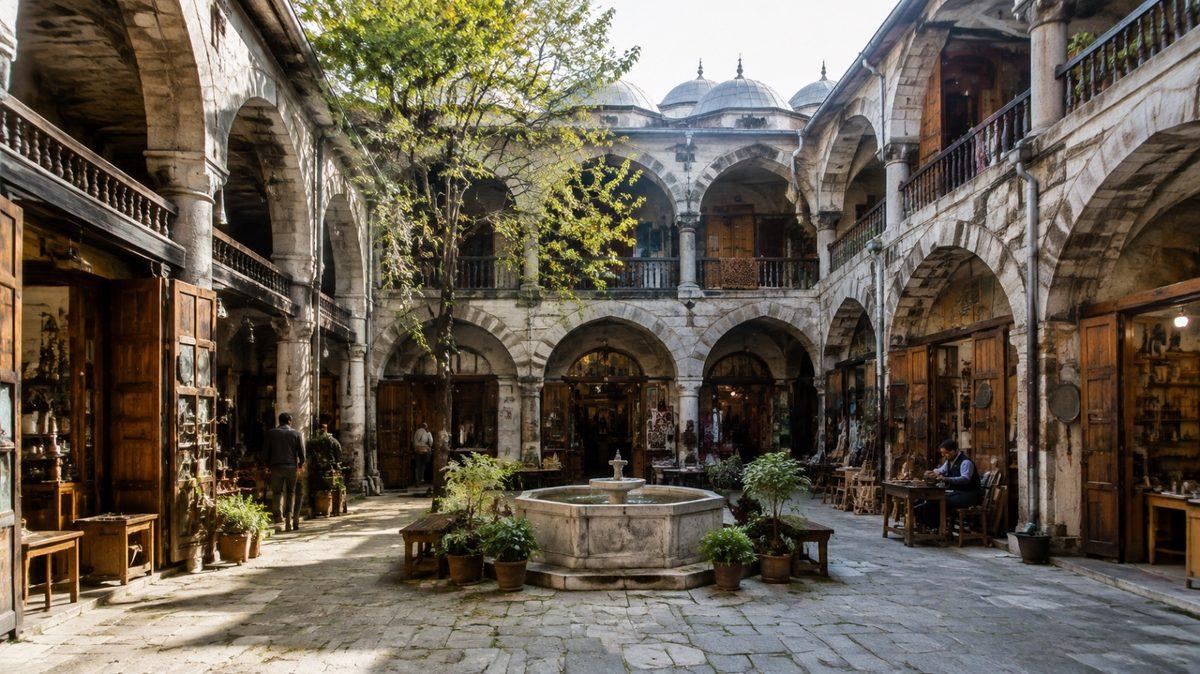
Step off a main lane of the Grand Bazaar, through a doorway you'd never look at twice, and the noise drops away. There's a plane tree, a fountain and a tea stall that has been running since 1955. A jeweller is mending chains for Spanish customers who come back every year. A carpet dealer whose family has traded since 1890 is showing handwoven rugs that are 60 or 70 years old.
This is a han, and old Istanbul is full of them. For centuries these courtyard buildings were warehouse, office and inn all at once: somewhere a merchant could unload his goods, strike a deal and sleep upstairs. They were also how the Ottoman elite did good, with the rent paying for mosques and charities.
Many still do business today, and that's the thrill of them. No ticket booth, no audio guide, just centuries of trade carrying on around you. Here are five worth finding, and the stories behind their doors.
1. Zincirli Han: the chain nobody can explain
Start with the prettiest. Terracotta walls and green shutters make this the most photogenic stop on the walk, and it's one of the better kept.
The name means "chained", but nobody agrees why. One story puts a great chain over the gate. Another says chains guided rainwater down from the roof. Even its age is a puzzle: most accounts say 1708, while the city's tourism site says the 16th century.
Good to know: Conservation work was announced in September 2026, with no timetable published, so access may change. It's on the bazaar's north side, and the bazaar closes on Sundays and public holidays.
2. Kürkçü Han: the Furriers' Han with no fur
Head downhill into Mahmutpaşa and you reach what's generally considered the city's oldest surviving han. It went up around the 1460s, soon after the Ottoman conquest, built by the grand vizier who gave this district its name.
The name means Furriers' Han, but don't come looking for fur. What you'll find is wool. Climb the stairs and the upper floors fill with colourful yarn, which is why one travel writer called it a "knitters' paradise". Five centuries of alterations show, but this is still a place where people come to shop, then sit down with a tea.
Good to know: It's on Mahmutpaşa Yokuşu, in the middle of a busy shopping district.
3. Büyük Yeni Han: where the money was
The name means Great New Han. It has been "new" since the 1760s, when Sultan Mustafa III built it just next door.
It quickly became a financial address. A register from 1780 shows moneychangers in 74 of its 164 rooms, in a profession then dominated by Istanbul's Armenian community. They were the people who financed and guaranteed big deals. Later, a public savings institution ran from its upper floor until 1927.
Look up from the street. The top-floor rooms jut out over the steep hill, and high on one corner are the worn remains of a carved stone birdhouse. Even the bankers, it seems, made room for the birds.
Good to know: It's on Çakmakçılar Yokuşu and full of working businesses, so go in working hours and be ready to be turned away.
4. Büyük Valide Han: gold, ceremonies and a collapsing roof
Cross the street to the biggest han in Istanbul and the wildest story on this list. It was commissioned by Kösem Sultan, mother of two sultans and one of the most powerful women the empire ever saw. Valide means the sultan's mother.
An Ottoman chronicler claimed she kept twenty chests of gold in its tower, a structure probably older than the han itself and likely Byzantine. After she was murdered in 1651, the fortune went to the state.
The han had a long second act. In 1652 a French traveller called it the finest in the city. Merchants from Iran made it their base, and their Muharram ceremonies became a spectacle: one account from the late 1800s describes 8,000 onlookers. Unlicensed printers are said to have worked here too.
Then came Instagram. About a decade ago, visitors paid a single lira to climb onto the roof and jump on the domes for photos. Parts of the roof gave way and the door was sealed. In June 2026, a fire damaged the roof as well. No one was reported hurt, and we found no published account of the cause or the full damage.
Good to know: We found no official word that the roof has reopened, so ignore old advice about tipping for the key. Workshops and small shops remain below, but watch your step: press reports have described worn floors and stairs without railings.
5. Balkapanı Han: honey on Byzantine foundations
Finish downhill in Tahtakale, near the Spice Bazaar. Bal means honey and a kapan was an official depot, but Ottoman orders show this one also handled oil, cotton, sugar, coffee, soap, cheese and salt. In 1725–26, when cotton sold elsewhere sent prices out of control, an order marched the trade back here. It's also said that the city's shopkeepers once brought their scales here to be checked and stamped.
A 17th-century traveller described it as big as a castle. Underneath, the story goes back further: the cellars are Byzantine, older than the empire that gave the han its name. You may hear that Venetians or Genoese built it. Nobody has proven that, which has never stopped anyone telling the story.
The best tale here is more recent. One shopkeeper told Anadolu Agency in 2022 that she went looking for a shop to rent in Eminönü, got snapped at, and walked angrily into a han for a tea. She asked at the tea house, found a shop and became the third woman to open one there. Nearby, a man who had spent 57 years in the building remembered the old days simply: "We were like a family with young and old."
Good to know: This is a working wholesale building. Don't count on seeing the cellars.
How to walk it
The order above runs mostly downhill, from the bazaar towards the Golden Horn. The first four hans sit within a few hundred metres of each other, and Balkapanı lies further down.
- Start: T1 tram to Beyazıt-Kapalıçarşı.
- Finish: The Spice Bazaar and Eminönü.
- When: Monday to Saturday during working hours.
- Allow: A morning or an afternoon.
- Wear: Good shoes. The streets are steep, uneven and crowded.
These are workplaces, so say merhaba, buy something if you can and ask before photographing anyone. If a door is shut, move on. There's always another one.
Prefer company? Smileys Community is walking through the hans together on Saturday, 7 November, at 13:00, starting at Zincirli Han. It's a relaxed social outing rather than a guided tour, and its route takes in other hans as well as some of those above.
Go while they're still like this
Change is coming. Fatih Municipality's revival plan puts three of these hans in its first phase, aiming to restore them and give them new uses. We found no published timetable, and it isn't clear yet what that means for the people working there today.
For now, the hans remain what they were built to be. Nobody put them up to be admired. They were made to store honey, change money and pay for mosques, and people still come here to do business.
So go when the doors are open. Buy a ball of wool or a glass of tea. You'll be a customer rather than a sightseer, and the hans have always known what to do with those.
Smileys Community: Discover Istanbul beyond the obvious.
Comments