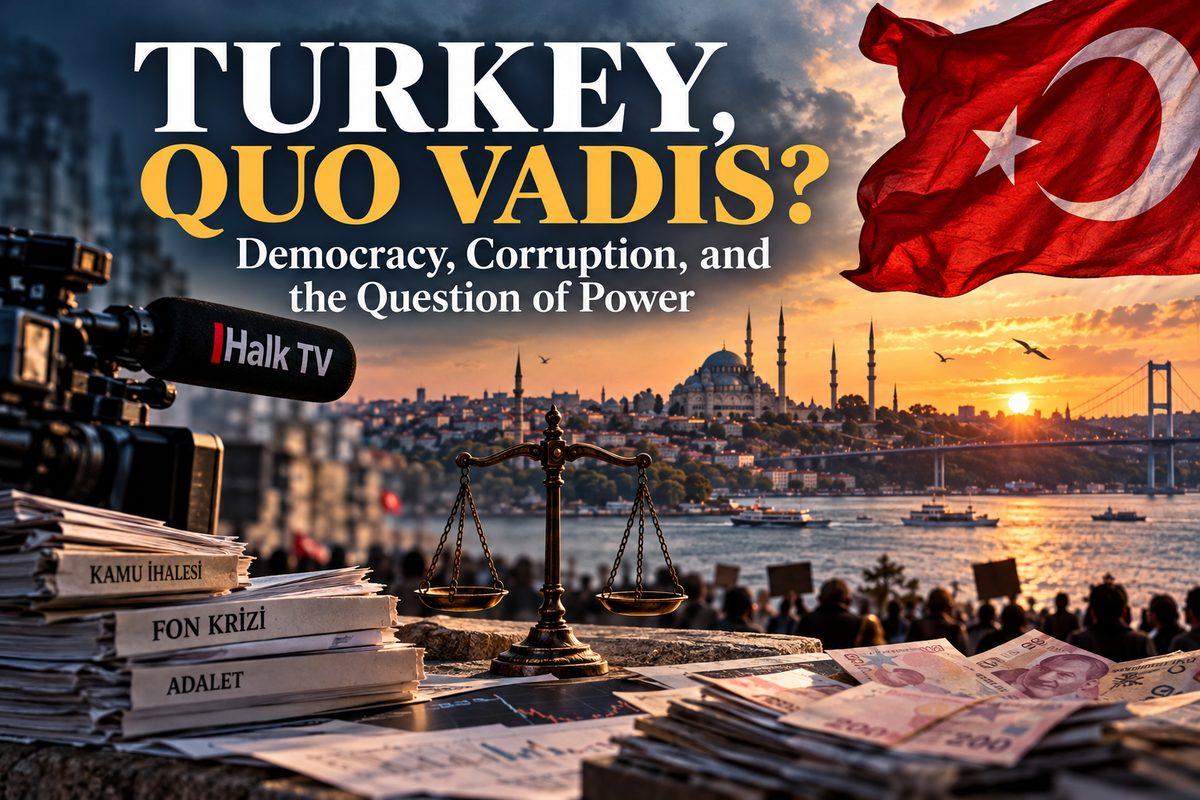
Turkey, Quo Vadis? Democracy, Corruption, and the Question of Power
From the Halk TV takeover to the investment fund crisis, Turkey faces growing questions about government pressure, corruption, justice, and accountability.
Nate
Published 14 October 2026 · 👁 20 views
Where is Turkey going?
Turkey has elections, political parties, a parliament, and courts. But democracy is about more than having these institutions. It is also about whether they can operate independently and hold those in power accountable.
Recent developments have brought several concerns into focus: corruption investigations, government pressure on the media, the independence of the judiciary, and the protection of ordinary citizens.
The latest Halk TV controversy and Turkey’s investment fund crisis have made these questions especially urgent.
Halk TV: A New Test for Press Freedom
On October 14, Turkish police raided the Istanbul headquarters of Halk TV, one of the country’s prominent opposition-oriented broadcasters.
The investigation involves the channel’s chairman, Cafer Mahiroğlu, who is accused of bribery, bid rigging, and money laundering connected to municipal contracts.
Mahiroğlu denies the allegations.
Authorities issued detention warrants for 17 people, with 11 taken into custody. Following a court decision, Turkey’s Savings Deposit Insurance Fund (TMSF) was appointed trustee over Halk TV and other companies linked to Mahiroğlu. The channel’s broadcasts were temporarily halted.
The government has a responsibility to investigate credible corruption allegations. Nobody should be above the law.
But placing an independent news organization under state-appointed management raises another question: can its journalists continue reporting freely, especially when their coverage is critical of the government?
Investigating corruption and protecting press freedom should not be mutually exclusive.
Corruption: Who Investigates the Powerful?
Corruption is not simply about politicians accepting bribes. It can involve government contracts, public tenders, favoritism, and businesses benefiting from political connections.
In Turkey, the transparency of public spending and major government projects has long been questioned by journalists, opposition parties, and anticorruption organizations.
Critics point to procurement exemptions and limited competition as potential risks for favoritism and misuse of public money.
These concerns do not prove that particular contracts are corrupt. But they underline the importance of independent oversight.
Investigations involving opposition politicians, including Istanbul Mayor Ekrem İmamoğlu, have also raised questions about whether corruption laws are applied consistently.
The government maintains that these are legitimate judicial investigations. Opposition representatives argue that some proceedings are politically motivated.
The public needs confidence that allegations involving government officials, politically connected businesses, and opposition politicians receive the same scrutiny.
Corruption should be investigated wherever the evidence leads, regardless of political connections.
Turkey’s Fund Crisis: Billions at Stake
Turkey’s investment fund crisis has brought financial regulation and political accountability into the spotlight.
In September 2026, authorities ordered the liquidation of 131 investment funds following problems with investor withdrawals and allegations of market manipulation.
According to Reuters, the funds had accumulated more than $20 billion in assets, with nearly half a million investors exposed.
Some funds had promised or delivered extraordinary returns, raising questions about how their investments were valued and whether share prices had been manipulated.
The investigation has also reached politically connected individuals.
Former minister Fatma Betül Sayan Kaya and her husband, İlyas Kaya, were named as suspects in the investigation. Being named as a suspect does not establish guilt.
The government has announced plans to protect smaller investors and establish a legal framework for the liquidation process.
But important questions remain.
Were regulators too slow to respond? Who benefited from suspicious transactions? Will investors recover their savings? And will the investigation examine everyone involved, regardless of political influence?
The crisis has also become a press freedom issue, with journalists facing legal proceedings over their reporting and commentary about the scandal.
When people’s savings are at risk, transparency and accountability become more than political arguments. They become personal concerns.
Government Pressure: The Cost of Speaking Out
Government pressure does not always involve arrests.
It can also come through financial penalties, broadcasting restrictions, criminal investigations, and limits on online expression.
Human Rights Watch and other organizations have documented concerns about restrictions affecting journalists, opposition politicians, civil society, and peaceful protesters in Turkey.
Turkey’s broadcasting regulator, RTÜK, has been criticized for imposing disproportionate fines and broadcasting suspensions on opposition-oriented media.
Authorities maintain that restrictions and legal proceedings are necessary in certain circumstances to enforce laws and protect public order.
Critics argue that some measures discourage legitimate criticism.
The consequences can extend beyond journalists.
A business owner may hesitate to criticize economic policy. A university lecturer may avoid a controversial subject. An ordinary citizen may think twice before sharing an opinion online.
This is known as self-censorship.
Freedom of expression means little if people are afraid to exercise it.
Justice and the Concentration of Power
Turkey’s presidential system gives substantial executive authority to the president.
Supporters argue that it allows faster decisions and more stable government. Critics question whether parliament and the judiciary can provide sufficiently effective oversight.
The independence of the courts is particularly important.
Judges and prosecutors must be able to investigate government officials, opposition politicians, business owners, and ordinary citizens without political interference.
Human Rights Watch and European human rights institutions have raised concerns about judicial independence and Turkey’s failure to implement certain European Court of Human Rights judgments.
The same debate extends to local government.
The suspension of elected mayors and appointment of government trustees in some municipalities have raised questions about the balance between legal accountability and the choices made by voters.
An elected official should not be immune from investigation. But investigations must follow fair procedures and respect legal rights.
Justice should depend on evidence and the law, not political affiliation.
The Economic Price of Weak Institutions
Corruption and uncertainty about the rule of law can affect the economy.
Businesses need fair competition, predictable regulations, and courts they can trust.
Investors need confidence that contracts will be respected and public decisions will be transparent.
When government spending is poorly supervised, taxpayers may receive less value for their money.
And when businesses fear favoritism or unpredictable legal decisions, investment and economic confidence can suffer.
Turkey’s inflation and cost-of-living challenges have many causes. They cannot be attributed solely to corruption or politics.
But transparent institutions and consistent enforcement of the law are important foundations for economic stability.
Democracy Is More Than Voting
Elections are essential, but democracy does not end when votes are counted.
People also need independent journalism, fair courts, the right to peaceful protest, and the freedom to question government decisions.
Parliament must be able to examine public spending. Journalists must be able to investigate powerful institutions. Citizens must have ways to challenge decisions that affect their lives.
These rights should apply to everyone, whether they support the government, the opposition, or neither.
A democratic society needs disagreement. It also needs institutions capable of resolving disagreements fairly.
Quo Vadis, Turkey?
Quo vadis? means Where are you going?
It is a question worth asking about Turkey today.
The Halk TV takeover, the investment fund crisis, corruption investigations, and concerns about government pressure are different stories. But they share one important theme: accountability.
Who investigates the powerful? Who protects citizens when institutions fail? Who ensures that public money is spent fairly? And who protects the right to question government decisions?
These questions are not simply about President Erdoğan, the AKP, or the opposition.
They concern the institutions that should protect everyone, regardless of who governs.
Turkey needs effective law enforcement, independent courts, transparent public spending, and journalists who can report without improper interference.
It also needs citizens who can participate in public life and question those in authority.
The future of democracy depends not only on who holds power, but on whether that power can be questioned and held accountable.
So, quo vadis, Turkey?
Perhaps the most important question is whether everyone can freely ask where their country is going.
Editorial note: This article reflects reporting available on October 14, 2026. Criminal allegations are not findings of guilt. The article distinguishes allegations, official statements, and concerns raised by independent organizations.
Sources checked
Sound like your kind of Istanbul?
Smileys is where people here meet in real life — dinners, walks, clubs. Small, curated, no feed to scroll.