 Safety & Emergencies
Earthquake Preparedness in Istanbul: Before, During and After
by Nate
Published 26 September 2026 · 5 min read · 👁 18 views
Quick summary
Istanbul sits near an active fault. What to check before you rent, how compulsory earthquake insurance (DASK) works, your assembly area, an emergency bag, and what to do during and after a quake.
Rules and requirements change. This article explains how the process works in practice — always confirm the current requirements with the official source listed at the end of this article before you act on it.
Istanbul lies close to the North Anatolian Fault, which runs beneath the Marmara Sea. The 1999 İzmit earthquake devastated the region, and on 23 April 2025 a magnitude 6.2 earthquake off Silivri shook the whole city. Nobody can predict when the next large earthquake will come, and you should ignore anyone who claims to. What you can do is prepare — and most of it takes an afternoon.
This guide is practical information drawn from official Turkish sources, not professional or engineering advice.
Before: where you live matters most
The building you live in is the biggest factor in how an earthquake affects you. Before you rent, ask:
When was the building constructed? Building codes have been tightened over the years, most recently in 2018. A newer building is not automatically safe and an older one is not automatically unsafe, but the question is worth asking.
Has it been assessed or strengthened? Ask the owner whether they have commissioned an official risk assessment (riskli yapı tespiti) through a Ministry-licensed institution, and whether the building has been strengthened. Only owners can request that assessment — a tenant can't.
Does it have compulsory earthquake insurance (DASK)? See below.
AFAD's Türkiye Earthquake Hazard Map (you log in with e-Devlet) shows how strongly the ground may shake at a location. It describes the ground, not the building — it cannot tell you whether a particular building is safe.
Compulsory earthquake insurance (DASK)
Compulsory Earthquake Insurance, issued through the Natural Disaster Insurance Institution (DASK), is required under Law No. 6305 for many residences within municipal limits and other covered units — exceptions apply. It is checked when property is bought or sold and when electricity or water subscriptions are opened or transferred.
It is normally arranged by the owner. A tenant can also take out the policy as policyholder, but it still covers the owner's building.
It covers damage to the building up to a set limit. It does not cover your furniture, electronics or other belongings — that needs separate home contents insurance (konut sigortası).
You can check a policy on DASK's website, but not by address alone — it needs the policy number or the address code together with an ID or tax number, so ask your landlord. Alo DASK is on 125.
Know your assembly area
Assembly areas (toplanma alanları) are open spaces chosen as safe places to gather in the first hours after a disaster. Find yours before you need it:
e-Devlet: search for "Acil Toplanma Alanı Sorgulama" after logging in. Foreigners with a valid residence permit can get e-Devlet access with their foreign ID number and a password from a PTT branch.
AFAD Acil app: shows assembly areas on a map and lets you call or message 112 with your location. Registration asks for your phone number and an identity number.
Istanbul Metropolitan Municipality city map (sehirharitasi.ibb.gov.tr) also shows assembly and temporary shelter areas.
Agree on a meeting point with the people you live with — and with friends — in case phones don't work.
Prepare an emergency bag
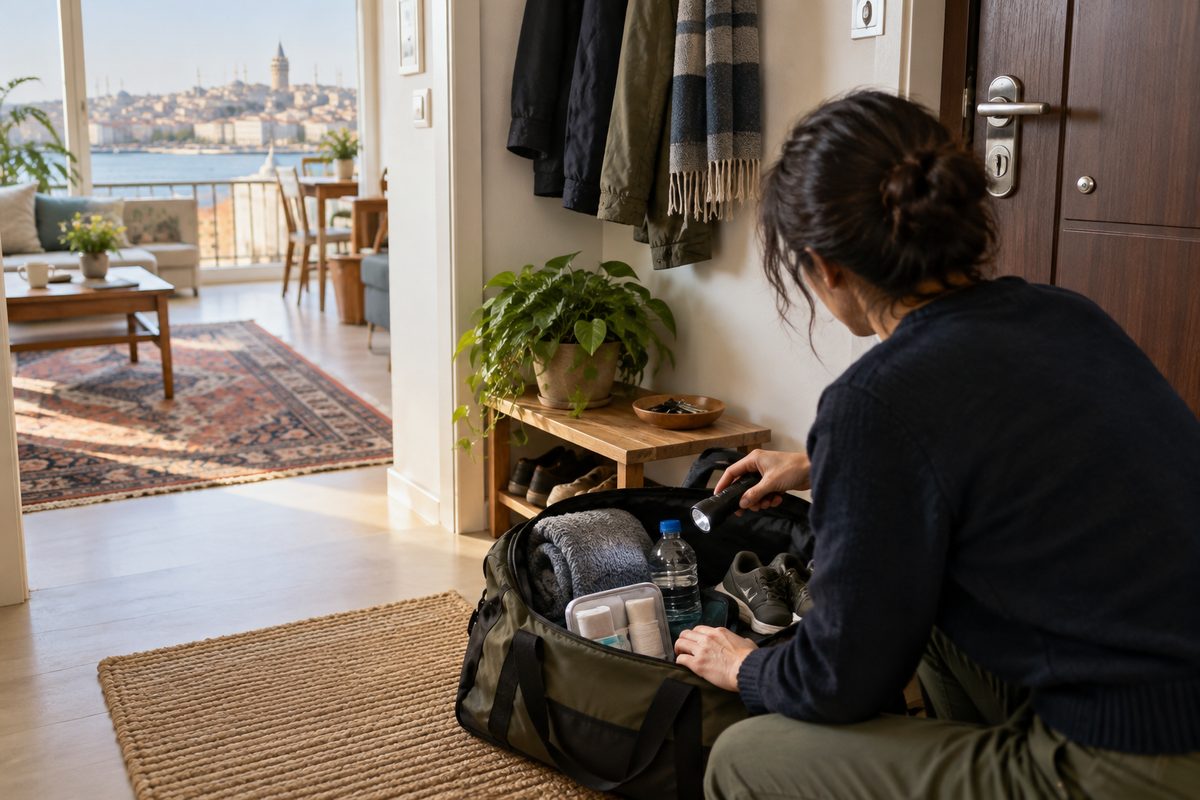
AFAD recommends a disaster and emergency bag to cover your needs for the first 72 hours after an earthquake, until help arrives. Keep it somewhere easy to grab. AFAD's list includes:
Enough drinking water for everyone in the household, and long-lasting, high-energy food
A first-aid kit, and any medicines you take regularly with their prescriptions
A torch, a battery-powered radio and spare batteries
A whistle, a pocket knife and scissors
A blanket or sleeping bag, underwear, socks, a raincoat and clothes for the season
Hygiene supplies: soap, disinfectant, a toothbrush and toothpaste, wet wipes, toilet paper and sanitary pads
Paper and a pen
Copies of important documents — your passport, residence permit, insurance policies including DASK, and bank documents
What your pets need
Check the food, water and medicines regularly for expiry dates, and update the clothes for the season. Our own additions: a little cash and a charged power bank.
During an earthquake
If you are indoors, Drop, Cover, Hold On (Çök-Kapan-Tutun): get down, protect your head and neck, and hold on next to or under a sturdy piece of furniture until the shaking stops. Stay where you are while it shakes.
Keep away from windows, balconies, bookcases, kitchen cupboards and anything that can fall.
Don't run for the door, the stairs or the lift.
Outdoors: move away from buildings, power lines, trees and poles to open ground.
In a vehicle: pull over away from buildings and overhead hazards and stay inside.
After the shaking stops
Don't use matches, lighters or electrical switches. If there is no smell of gas and you can do so safely, close the gas and water valves and switch off the electricity.
Leave by the stairs, never the lift, and go to your assembly area. Stay out of damaged buildings — aftershocks follow.
Call 112 for emergencies. Keep other calls short so the network stays free; the AFAD Acil app can send messages when calls don't get through.
If you are near the Marmara shore, move away from the coast and toward higher ground after a strong earthquake — tsunamis are possible — and follow official alerts.
If you are trapped, don't light matches or lighters, cover your mouth and nose, and tap on pipes or use a whistle rather than shouting.
Staying informed
Check AFAD and the Kandilli Observatory for official information on recent earthquakes, and ignore rumours and "predictions" on social media.
If you are a foreign national, check whether your country's embassy or consulate offers registration for its citizens in Türkiye, so they can reach you in an emergency.
Sources
Verify the current rules yourself — where they come from.
- AFAD — What to do during an earthquakeafad.gov.tr
- AFAD — How to prepare a disaster and emergency bagafad.gov.tr
- AFAD Istanbul — Finding your assembly areaistanbul.afad.gov.tr
- AFAD Istanbul — AFAD Acil mobile appistanbul.afad.gov.tr
- 112 Emergency Call Centre — AFAD Acil app112.gov.tr
- DASK — Frequently asked questionsdask.gov.tr
+ 8 more sourcesShow fewer
- DASK — Policy lookupdask.gov.tr
- DASK — Earthquake insurance and electricity subscriptionsdask.gov.tr
- AFAD — Türkiye Earthquake Hazard Mapafad.gov.tr
- AFAD — 23 April 2025 Silivri (Marmara Sea) earthquake reportdeprem.afad.gov.tr
- Istanbul Metropolitan Municipality — city map (assembly areas)sehirharitasi.ibb.gov.tr
- AFAD Muğla — Staying safe after an earthquake (gas, electricity, coast)mugla.afad.gov.tr
- Ministry of Environment, Urbanisation and Climate Change (Istanbul) — the risky-building processistanbulakdm.csb.gov.tr
- e-Devlet — access for foreign nationalsturkiye.gov.tr
💬
Got a tip or a twist your case taught you?
Tell us and we'll fold it into the article, with credit.
More in Safety & Emergencies
Emergency Numbers in Türkiye: Call 112 and Other Numbers Worth Saving
In an emergency anywhere in Türkiye, call 112. It covers ambulance, police, fire, gendarmerie, coast guard, forest fires and disaster response. Calls are free, including from a mobile without a SIM card. English-language support is available. Below: what to say, other useful numbers, finding an on-duty pharmacy, replacing a lost passport, and locating your earthquake assembly area.
Scams & Tourist Traps in Türkiye: How to stay safe without becoming paranoid
Türkiye is a safe and welcoming destination. Most visitors never experience a scam, but like any popular tourist destination, a few common scams exist. Knowing what to watch for is the best way to avoid them and enjoy your stay.