Renting an Apartment in Istanbul: What Foreigners Should Know
by Nate
Published 11 August 2026 · 6 min read · 👁 75 views
Quick summary
Renting an apartment in Istanbul as a foreigner is not just about finding a nice flat at the right price. The neighborhood you choose can affect your daily life far more than the apartment itself. You need to understand deposits, agent fees, aidat, heating, the contract, address registration and, importantly, the questions that reveal problems before you sign.
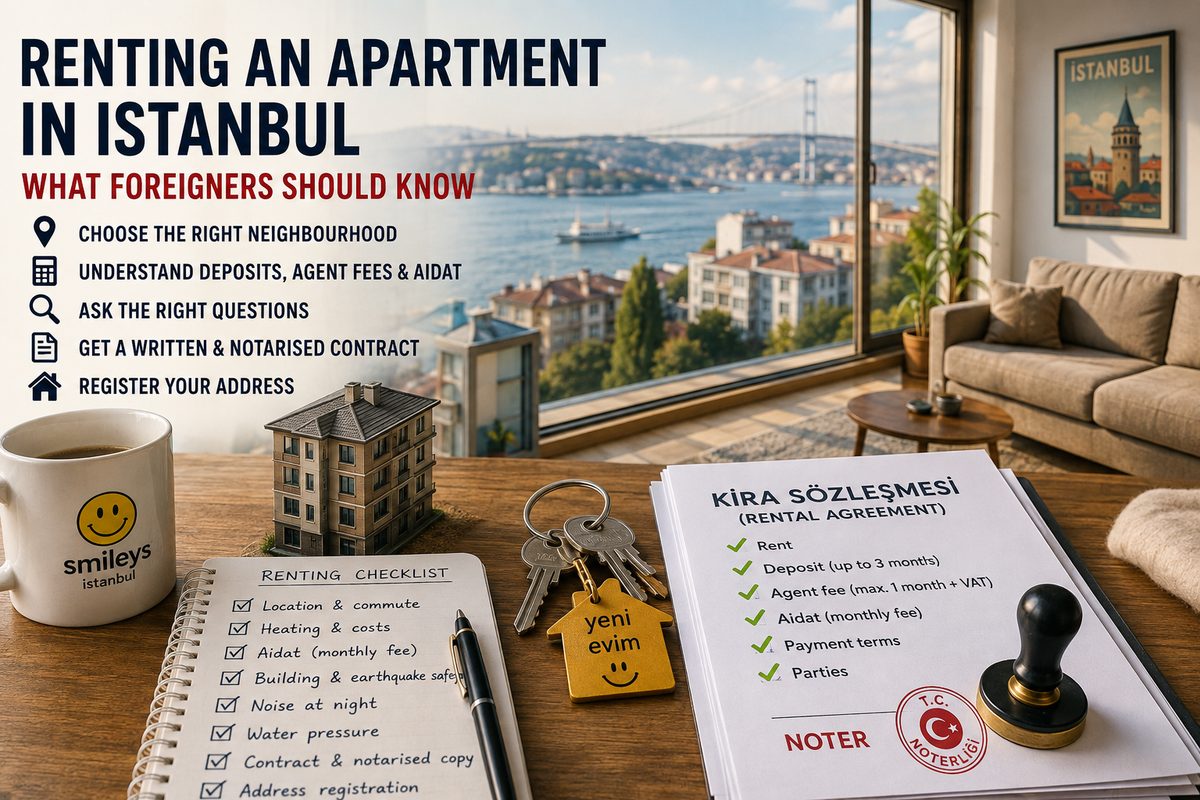
Pick the side of the city first
Istanbul is not one housing market. It is dozens.
Before you look at a single listing, decide which side of the Bosphorus you want to live on and roughly where you need to be on weekday mornings. A flat that is perfect on paper but a ninety-minute commute from everything you do is not a good flat.
Be honest about your actual week.
If your life is on the European side, a cheaper place across the water may save you money on rent but cost you hours in commuting, transport and energy. Eventually, you may simply stop going out.
Choose your neighborhood before you choose your apartment.
How the money works
Expect to pay a deposit (depozito). In practice, one or two months' rent is common, but Turkish law allows a residential rental deposit of up to three months' rent.
The first month's rent is also typically paid at the beginning of the tenancy, although the exact payment schedule should be stated in the contract.
If you use an estate agent (emlakçı), there is usually a brokerage fee. For residential rentals, the legally permitted service fee is capped at one month's rent, excluding VAT. Unless the parties agree otherwise in writing, the fee is shared equally between the landlord and tenant.
Ask exactly how much you will pay — rent, deposit, agent fee and VAT — before committing to the apartment.
Rent increases are capped by law. When a residential lease renews, the increase can't exceed the change in the consumer price index (TÜFE) averaged over the previous twelve months — the rate TÜİK publishes each month. The temporary 25% cap that applied from 2022 ended on 1 July 2024, so with inflation where it is, expect a sizeable rise at each renewal and check the current rate rather than taking a landlord's figure on trust.
Then there is aidat — the building's monthly maintenance charge. It can cover things such as cleaning, lifts, security, a caretaker, common areas and shared heating, depending on the building.
It is separate from rent and can be surprisingly expensive.
A cheap apartment with a high aidat can end up costing more than a more expensive apartment in a building with a low aidat.
Always ask for the current monthly amount before you sign.
The questions that reveal a bad flat
Viewings are short, and everything can look fine on a sunny afternoon.
Ask these questions anyway:
How is it heated, and who pays?
Individual gas heating (kombi) generally means you control when the apartment is heated and pay for the gas you use.
Central heating works differently, and the way costs are divided depends on the building.
Ask what system the building uses and what previous tenants typically paid during winter.
Is there damp?
Look carefully at ceiling corners, behind furniture, around windows and inside bathrooms.
Older or poorly maintained buildings can have moisture and damp problems that are not obvious during a quick viewing.
If something smells musty, investigate it.
What floor is it, and is there a lift?
A fifth-floor walk-up can feel charming when you first see it.
It may feel very different after carrying groceries home every day.
What is the water pressure like?
Turn on the taps.
Ask whether there are regular water interruptions and whether the building has a water tank or other backup system.
What is the street like at night?
A quiet street at 2pm can be very different at midnight.
If you are serious about the apartment, visit the area again in the evening. Listen for traffic, restaurants, bars, construction and other sources of noise.
What is the building's earthquake situation?
Ask when the building was constructed and whether it has undergone structural strengthening or earthquake-related assessment.
Do not assume that a newer building is automatically safe or that an older building is automatically unsafe. Building-specific construction and structural information matters.
For an apartment in Istanbul, this is a question worth taking seriously. AFAD's earthquake hazard map (through e-Devlet) shows the hazard level for an area, not whether a particular building is sound — only a licensed structural assessment does that. Our earthquake guide covers what to look for and how to prepare.
The contract
Get a written rental agreement.
If you intend to use the lease as proof of accommodation for a residence-permit application, the relevant Migration Management documentation requires a notarised copy of the rental agreement, with the landlord's details on it. Our residence permit guide explains the rest of the application.
Before signing, make sure the person renting the apartment to you is the owner or is legally authorized to do so. Do not rely only on a verbal promise that someone "is acting for the owner."
Your contract should clearly state the rent, deposit, payment arrangements, parties to the agreement and other important conditions of the tenancy.
Keep your copy of the signed contract and payment records.
Check the address before you sign
This is particularly important for foreigners.
If you need the apartment for residence-permit or address-registration purposes, check that the specific address is suitable for your situation before signing and paying.
Do not assume that every apartment available for rent can automatically be used for every immigration or registration purpose. Since 2022 the migration authorities have closed some neighborhoods to new address registrations for certain groups of foreigners, and residence permit applications in some districts have been restricted. Some sources report that these restrictions were lifted in 2026, but we have not found an official announcement confirming it — so ask the provincial migration directorate (or YİMER 157) whether you can register at that exact address before you pay anything.
Register your address
Once you move in, make sure your address information is properly registered and kept up to date.
If you change your address later, the relevant authorities need to be informed according to the applicable rules.
Utilities may also need to be transferred into your name. The exact requirements vary depending on the utility and your circumstances, so check what documents are required rather than assuming the process is identical for everyone. Our moving-in guide covers electricity, water, gas and aidat.
Where to look
Online property platforms are where most searches start, but Istanbul's rental market also works through local networks.
Walking around the neighborhood you want and looking for kiralık signs can still work. Local estate agents may know about apartments that have not yet appeared online.
And this is one area where knowing people genuinely helps.
Someone who already lives in the building can tell you about:
The landlord
The actual aidat
The neighbors
The building management
The water pressure
The heating costs
The noise at night
And the things the listing will never mention
A five-minute conversation with a neighbor can sometimes tell you more than a thirty-minute viewing.
A note on prices
Istanbul rents have changed dramatically in recent years and can vary enormously between neighborhoods, buildings and even individual streets.
That makes generic Istanbul-wide rental figures difficult to keep accurate for long.
Instead of asking, "How much is an apartment in Istanbul?", ask:
"How much are people paying right now for this type of apartment in this specific neighborhood?"
Look at several comparable listings, ask local residents and speak to more than one agent.
And remember that a listing price is an asking price — not necessarily the final price you will agree to.
The Smileys rule
Don't fall in love with the apartment before you understand the neighborhood.
The apartment is where you sleep.
The neighborhood is where you live.
Sources
Verify the current rules yourself — where they come from.
- Turkish Code of Obligations (6098) — deposit cap (Art. 342) and rent increases (Art. 344)mevzuat.gov.tr
- Regulation on Real Estate Trade — agent service fee for rentalslexpera.com.tr
- e-İkamet — short-term residence permit checklist (notarised lease with landlord details)e-ikamet.goc.gov.tr
- Presidency of Migration Management — neighbourhood closure notice (2022)goc.gov.tr
- AFAD — Türkiye Earthquake Hazard Map (area hazard, not building safety)tdth.afad.gov.tr
- e-Devlet — address registration and official documentsturkiye.gov.tr
The overview, as a story
Finding an Apartment in Istanbul: What Nobody Tells You
Finding an apartment in Istanbul can be exciting, but the real challenges often start after you find one. A practical guide to renting, contracts, residency zones, hidden costs, and avoiding common problems.
Quick links for this topic
Housing, utilities, and daily essentials — curated by the Smileys team.
💬
Got a tip or a twist your case taught you?
Tell us and we'll fold it into the article, with credit.
More in Home & Housing