Scams & Tourist Traps in Türkiye: How to stay safe without becoming paranoid
by Nate
Published 26 July 2026 · 7 min read · 👁 282 views
Quick summary
Many trips to Türkiye are trouble-free, but scams and theft do happen. The warning signs worth knowing — taxis, bills, street approaches, online scams — and what to do if something goes wrong.
Rules and requirements change. This article explains how the process works in practice — always confirm the current requirements with the official source listed at the end of this article before you act on it.
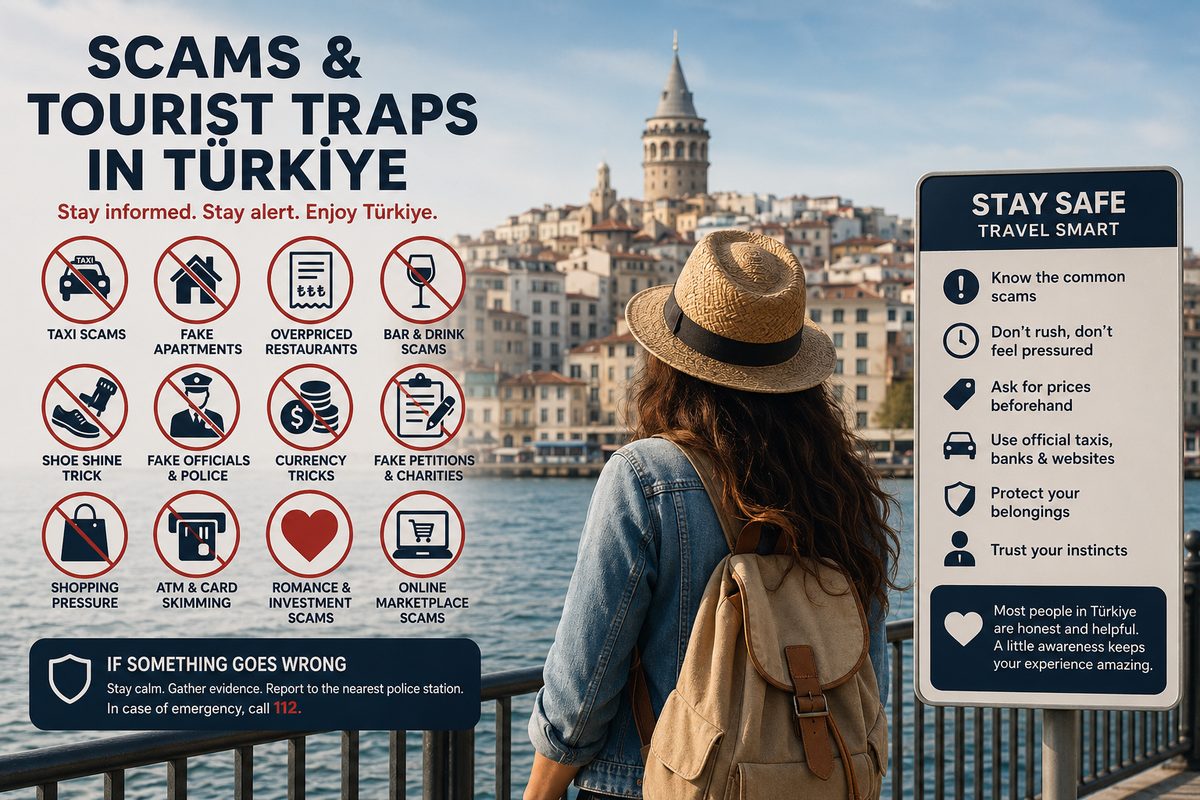
Many trips to Türkiye are trouble-free, but scams and theft do happen — UK travel advice notes that street robbery and pickpocketing are common in Istanbul’s major tourist areas. Knowing the warning signs is the best protection.
The Golden Rules
No matter where you are in Türkiye, these simple habits will protect you from most scams:
Never feel pressured into making an immediate decision.
Ask for prices before accepting any service.
Use official taxis, licensed businesses, banks, and government websites whenever possible.
Carry photo ID — your passport or residence permit. It is a legal requirement in Türkiye, and you should cooperate with official ID checks. Otherwise, never hand your passport to anyone except authorized officials.
Be cautious if someone you’ve just met seems unusually generous or overly friendly.
Trust your instincts. If something feels wrong, politely walk away.
1. Taxi Scams
While most taxi drivers are honest, complaints still occur, particularly around airports, tourist attractions, hotels, and nightlife districts.
Common scams include:
Taking unnecessarily long routes.
Refusing to use the meter.
Claiming the card machine is broken.
Saying you handed over a smaller banknote than you actually did.
Charging a fixed “tourist price.”
Stay safe
Use licensed taxis or trusted ride-hailing apps such as BiTaksi or Uber, which generally dispatch licensed taxis in Türkiye.
Make sure the meter is switched on at the beginning of the trip.
Follow your route using Google Maps.
Carry smaller banknotes when paying cash.
Verify the card payment amount before approving it.
If something feels wrong, note or photograph the taxi’s license plate.
2. Fake Apartment Listings
Rental scams are a risk worth watching for, especially when you’re new and searching from abroad.
Scammers copy genuine property photos, advertise unusually low prices, collect deposits, and disappear.
Warning signs include:
Prices well below market value.
Refusing in-person viewings.
Offering only video tours.
Requests for deposits before viewing.
Pressure to transfer money immediately.
Stay safe
View the property whenever possible.
Verify the owner’s or agency’s identity.
Never send a large deposit without a written contract.
Be cautious of landlords who claim to be “overseas” and unable to meet.
3. Residence Permit & Immigration Scams
New arrivals are often unfamiliar with Türkiye’s immigration procedures, making them common targets.
Scammers may:
Pretend to have connections within immigration offices.
Promise guaranteed approvals.
Sell fake health insurance.
Produce forged documents.
Charge excessive consultancy fees.
Stay safe
Residence permit applications begin through the official e-İkamet portal of the Presidency of Migration Management (Göç İdaresi Başkanlığı).
No lawyer, consultant, or agency can guarantee approval or claim to have special access to immigration officials.
Always verify anyone offering immigration services before making a payment.
4. Fake Police or Government Officials
Although uncommon, some scammers pretend to be police officers or government officials.
Remember:
Real police officers carry official identification.
Legitimate officers do not ask tourists to withdraw cash.
They will never ask you to transfer money to a “safe account.”
Carry your passport or residence permit and cooperate with official ID checks. But don’t hand over cash or transfer money to anyone making an unofficial demand: ask for official documentation, and verify it through proper channels — call 112 if you’re unsure whether you’re dealing with real officers.
5. Restaurant Bill Tricks
Most restaurants operate honestly, but tourist areas occasionally see billing disputes.
Common issues include:
Extra dishes added to the bill.
Different prices than those shown on the menu.
Service, table or couvert charges on the bill.
Separate English and Turkish menus with different prices.
Unrequested bread, water, or appetizers added to the bill.
Stay safe
Since 30 January 2026, Türkiye’s Trade Ministry rules say restaurants, cafés and similar businesses cannot charge service, table or couvert fees (or similar charges under another name), and complimentary starters served before you order can’t be charged either. Tips are voluntary.
Check menu prices before ordering.
Review your bill before paying.
Challenge anything you didn’t order and any service, table or couvert fee.
If a business won’t correct the bill, keep the receipt — you can get advice from the Trade Ministry’s consumer line, ALO 175.
6. The Bar Invitation Scam
A friendly stranger invites you for “just one drink.”
After arriving:
Drinks become extremely expensive.
Additional people unexpectedly join your table.
A large bill suddenly appears.
Staff pressure you into paying immediately.
UK travel advice warns about strangers offering to take you to a restaurant or nightclub — and that food or drink offered by strangers could be spiked.
Stay safe
Avoid bars recommended by people you’ve only just met.
7. Currency Exchange Tricks
Avoid exchanging money with people on the street.
Instead, use:
Licensed exchange offices.
Banks.
Airport exchange offices only when necessary, as their exchange rates are often less favourable.
Rates and fees vary between offices for legitimate reasons, so compare the full amount you’ll receive before exchanging. Always count your money before leaving and keep your receipt.
8. ATM Safety
Whenever possible, use ATMs attached to banks instead of standalone machines.
Before inserting your card, check for:
Loose card readers.
Hidden cameras.
Unusual attachments.
Signs that equipment has been tampered with.
Always shield your PIN while entering it.
9. Fake Charity & Petition Scams
Someone asks you to sign a petition, support a charity, or help a local cause.
While you’re distracted:
Your belongings may become exposed.
You’re pressured into making a donation.
A polite “No, thank you” is perfectly acceptable.
10. The Shoeshine Trick
A trick reported in Istanbul’s tourist areas:
A shoeshine worker “accidentally” drops a brush.
When you return it, they insist on cleaning your shoes before demanding payment.
Stay safe
Simply smile, decline politely, and continue walking.
11. Shopping Pressure
Bargaining is a normal part of shopping in bazaars and some independent stores.
However:
Never feel obligated to buy.
Compare prices between shops.
Walk away if you feel pressured.
Remember that change-of-mind returns for purchases made in physical shops are generally subject to the store’s own return policy unless the item is defective.
12. Online Marketplace Scams
Scammers frequently advertise electronics, phones, apartments, concert tickets, and other valuable items on online marketplaces and social media.
Stay safe
Meet in public places.
Test items before paying.
Avoid advance payments.
Verify the seller whenever possible.
13. Romance & Investment Scams
Many scams now begin through social media, messaging apps, dating platforms, or cryptocurrency groups.
After building trust, scammers often request money for:
Medical emergencies.
Customs fees.
Business investments.
Cryptocurrency opportunities.
Family crises.
Promises of guaranteed investment returns are always a warning sign.
Never send money to someone you’ve only met online.
14. Fake QR Codes
A trick seen in many countries: fake QR-code stickers placed over genuine ones.
Scammers may place them over restaurant menus, parking meters, or payment terminals.
Always check that a QR code appears legitimate before scanning.
15. Public Wi-Fi Risks
Free Wi-Fi is convenient but not always secure.
Avoid accessing online banking or making sensitive payments while connected to public Wi-Fi unless you’re using a trusted VPN.
16. SIM Card & eSIM Overcharging
Prices vary between sellers, and a higher price isn’t a scam in itself — but airport and tourist-area vendors can charge much more than the operators’ own stores.
Stay safe
Compare the full price and what’s included (data, validity, conditions), and buy from official mobile operator stores whenever possible.
If Something Goes Wrong
Stay calm.
Gather as much evidence as possible:
Photos
Receipts
Screenshots
Messages
Names of businesses
Vehicle license plates, if applicable
Report serious incidents to the nearest police station. If money or payment details are involved, contact your bank immediately — the sooner, the better the chance of stopping or recovering a payment.
If your passport has been lost or stolen, contact your country’s embassy or consulate immediately.
Emergency Assistance
112 – Emergency services (police, ambulance, fire and other emergency assistance)
Report fraud or theft to the nearest police station.
ALO 175 – the Trade Ministry’s consumer advice line, for disputes with businesses such as restaurant bills or shops (not emergencies).
Your bank, immediately, if card details or money are involved.
Contact your embassy or consulate if you lose your passport or require consular assistance.
Final Thoughts
Don’t let stories about scams discourage you from visiting or living in Türkiye. Many visitors quickly discover that everyday life is friendly, welcoming, and far less dramatic than online horror stories suggest.
The best protection isn’t fear—it’s awareness. Learn the common scams, stay alert in unfamiliar situations, and use common sense. With a little preparation, you’ll avoid the vast majority of problems and be free to enjoy everything Türkiye has to offer—from its rich history and vibrant cities to its incredible food, coastline, and hospitality.
Sources
Verify the current rules yourself — where they come from.
- 112 Emergency Call Centre (Ministry of Interior)112.gov.tr
- UK FCDO — Turkey travel advice: safety and securitygov.uk
- Trade Ministry — price tag regulation amended (no service, table or couvert fees), 30 Jan 2026ticaret.gov.tr
- Trade Ministry — ALO 175 consumer advice lineticaret.gov.tr
- Presidency of Migration Management — e-İkamet portale-ikamet.goc.gov.tr
💬
Got a tip or a twist your case taught you?
Tell us and we'll fold it into the article, with credit.
More in Safety & Emergencies
Lost or Stolen Passport, Residence Permit or Phone in Türkiye: What to Do
Step by step: the police loss report, your embassy, replacing a lost residence permit card, telling the migration office about a new passport, and blocking a lost phone and bank cards.
Earthquake Preparedness in Istanbul: Before, During and After
Istanbul sits near an active fault. What to check before you rent, how compulsory earthquake insurance (DASK) works, your assembly area, an emergency bag, and what to do during and after a quake.
Emergency Numbers in Türkiye: Call 112 and Other Numbers Worth Saving
In an emergency anywhere in Türkiye, call 112. It covers ambulance, police, fire, gendarmerie, coast guard, forest fires and disaster response. Calls are free, including from a mobile without a SIM card. English-language support is available. Below: what to say, other useful numbers, finding an on-duty pharmacy, replacing a lost passport, and locating your earthquake assembly area.