Meeting the Family: What to Expect When Your Partner Is Turkish
Your partner wants you to meet their family. What a first visit is usually like, the small gestures that mean a lot, and what it means when families start talking about "asking."
Nate
Published 17 November 2026 · Updated 19 November 2026
It usually starts casually. "My mother wants to meet you." Or: "We're having dinner at my parents' on Saturday. Come."
And suddenly the relationship you've been building over coffee dates and long walks by the water has a new audience: parents, maybe grandparents, an aunt who has already heard everything about you, and a younger cousin who wants to practice their English.
If your partner is Turkish, this meeting is often a bigger moment than it would be back home. Here's what it's usually like, and how to walk in feeling ready.
Why It Feels Like a Big Deal
In many Turkish families, family isn't a holiday-only affair. Parents may live nearby, Sunday breakfasts are a ritual, and big decisions are talked over with relatives. So when your partner brings you home, it often signals that they see a future with you, and the family knows it.
That doesn't mean you're being judged as a future spouse from the moment you walk in. But the visit may mean more to them than "come over for dinner" suggests.
There is also no single "Turkish family," just as, we argued in Love Without Borders, a passport doesn't tell you who someone is. A secular family in a big city, a religious family in a small Anatolian town and a family that has spent half its life in Germany will welcome you in very different ways.
Questions to Ask Before You Go
Your partner is your best guide. Worth asking them:
What do they already know about me? Some partners have told their family everything. Others have kept the relationship quiet, and this visit is the announcement.
Who will be there? "Meeting my parents" can turn into a table of twelve.
What should I call them? Older relatives are often called teyze (auntie) or amca (uncle), even by people who aren't related to them. Parents may prefer something more formal at first.
Is alcohol okay? Many families drink, many don't. Don't bring a bottle or order a drink at a family meal until you know.
Are there topics to avoid? Politics and religion are the obvious ones, but there may be others, like a family feud or a sore subject about someone's job.
The First Visit
Don't arrive empty-handed. A box of baklava, Turkish delight, good chocolates or flowers from a florist all work. Find out what their parents like; it's an easy win.
Know the greeting. You'll be met with "Hoş geldiniz" (welcome). The guest's reply is "Hoş bulduk," roughly "glad to be here." Learn this one before anything else.
Shoes off at the door. You'll probably be handed guest slippers. Accept them.
Greet the elders first. You may see your partner kiss the back of an older relative's hand and then touch it to their forehead. This is el öpmek, a sign of respect, seen especially during the bayram holidays. No one expects a guest to do it on a first visit, but if you offer, it is usually received warmly. A handshake and a smile are always fine.
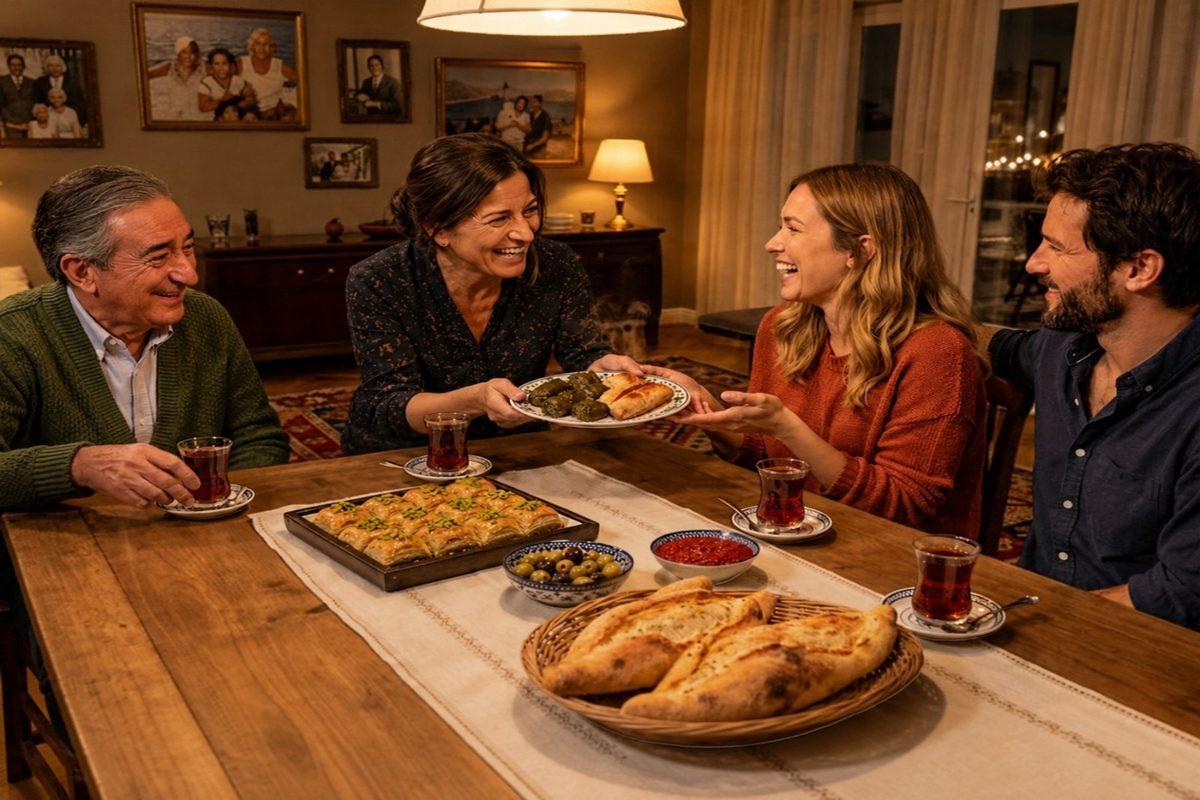
Expect to be fed. Turkish hospitality is generous, and saying no once rarely ends the conversation. A plate may be refilled the moment it's empty, and the tea will keep coming. If you're full, say so kindly and more than once: "Çok teşekkür ederim, doydum" (thank you so much, I'm full).
Thank the cook. "Eline sağlık" (literally "health to your hands") is what you say to whoever made the meal. Saying it in Turkish, however clumsily, may be the most appreciated thing you do all evening.
Offer to help, then accept the answer. Offering to clear the table is polite. In many homes, the guest is firmly told to sit down.
Don't plan a quick exit. Goodbyes take time. Saying you're leaving often starts another round of tea, and the last conversation may happen at the door with your coat on.
For everyday words and customs beyond the dinner table, see our handbook's Turkish Basics and Etiquette.
Staying Over
If you visit a family in another city, you may be invited to stay. Many families won't put an unmarried couple in the same room, however long you've been together, and some will set up a bed for one of you in the living room. Ask in advance rather than finding out at bedtime, and accept the arrangement gracefully. It's their home.
Holidays With the Family
The two bayrams are family time. During Ramazan Bayramı and Kurban Bayramı, families visit their elders, the younger generation kisses the hands of the older one, and children collect sweets and pocket money. Joining these visits is a sign that you're becoming part of the family. A box of sweets or chocolates is the classic thing to bring, especially for Ramazan Bayramı, which many people call Şeker Bayramı, the "sugar holiday."
During Ramadan, you may be invited to an iftar, the evening meal that breaks the fast. Arrive before sunset, and wait for the call to prayer, or for your hosts, before you start eating, even if the table is already full. Whether or not you fast, being invited is a warm gesture.
What They'll Want to Know
Be ready for questions that may feel personal if you're not used to them: what you do for work, where your family lives, how long you plan to stay in Türkiye and, sooner or later, whether you're thinking of getting married.
Most of the time this is curiosity and care, not an interrogation. Answer honestly, keep it warm and let your partner step in when a question needs a careful answer. Agree beforehand on how you'll handle "So, when's the wedding?"
If the family speaks little English and you speak little Turkish, don't worry. Smiles, photos on your phone and your partner translating (selectively, sometimes) carry a first visit further than you'd think.
When Families Start Talking About "Asking"
If the relationship gets serious, you may hear about kız isteme, "asking for the girl." Traditionally, the man's family visits the woman's family to ask, formally, for their blessing. The future bride serves Turkish coffee, and in a playful custom some families still keep, she may slip salt into the groom's cup to see if he drinks it without complaint.
If the answer is yes, there may be a söz (the promise) and later an engagement (nişan). The couple's rings are often tied together with a red ribbon, an elder of the family puts them on, and the ribbon is cut to applause.
How much of this a family follows varies enormously. Some do all of it with great ceremony, some keep a version of it with a wink, and some skip it completely. If it comes up, talk about what it would mean in their family, and how your own family's traditions could have a place too. For the legal side, see our guide to marrying a Turkish partner.
When It Doesn't Go Smoothly
Not every first meeting is warm. Some families worry about a partner from another country, another religion or simply a different life, and the fear underneath is often that their child will move away.
Be patient. Families often soften as they get to know you as a person rather than an idea. Let your partner lead the difficult conversations with their own family, and keep talking to each other about what you both need.
Some couples, because of religion, family expectations or who they love, wait a long time before introducing each other, or choose not to. That's a decision only the two of you can make.
Two Families, One Table
Meeting the family is about more than a good first impression. It's a glimpse of the world your partner grew up in, and often the beginning of a second family: one that sends you home with leftovers, worries when you travel and asks after your parents by name.
If you moved to Türkiye to be with your partner, their family can quickly become your whole social world. Moved to Türkiye for Love? is about building a life of your own alongside it.
In Istanbul, the Couples group is full of people who have sat at that table. And if you've already met the family, tell us in the comments: what surprised you most?
Comments