🇹🇷 Turkish Culture: What Every Erasmus Student Should Know
Tea at every turn, professors called hocam, food that keeps appearing, shoes off at the door and a few phrases that go a long way — the small cultural details of a semester in Türkiye.
Nate
2 October 2026 · 👁 19 views
🇹🇷 Turkish Culture: What Every Erasmus Student Should Know
After a few weeks in Türkiye, you start noticing things nobody explained during Erasmus orientation.
Why does everyone keep offering you tea? Why are students calling professors hocam? Why has saying “no thanks” to food somehow resulted in even more food appearing?
Welcome to the small cultural details of living in Türkiye.
You don’t need to understand everything immediately. But knowing a few things will make everyday life easier — and probably save you from a few confused looks.
☕ Tea Is Basically Infrastructure
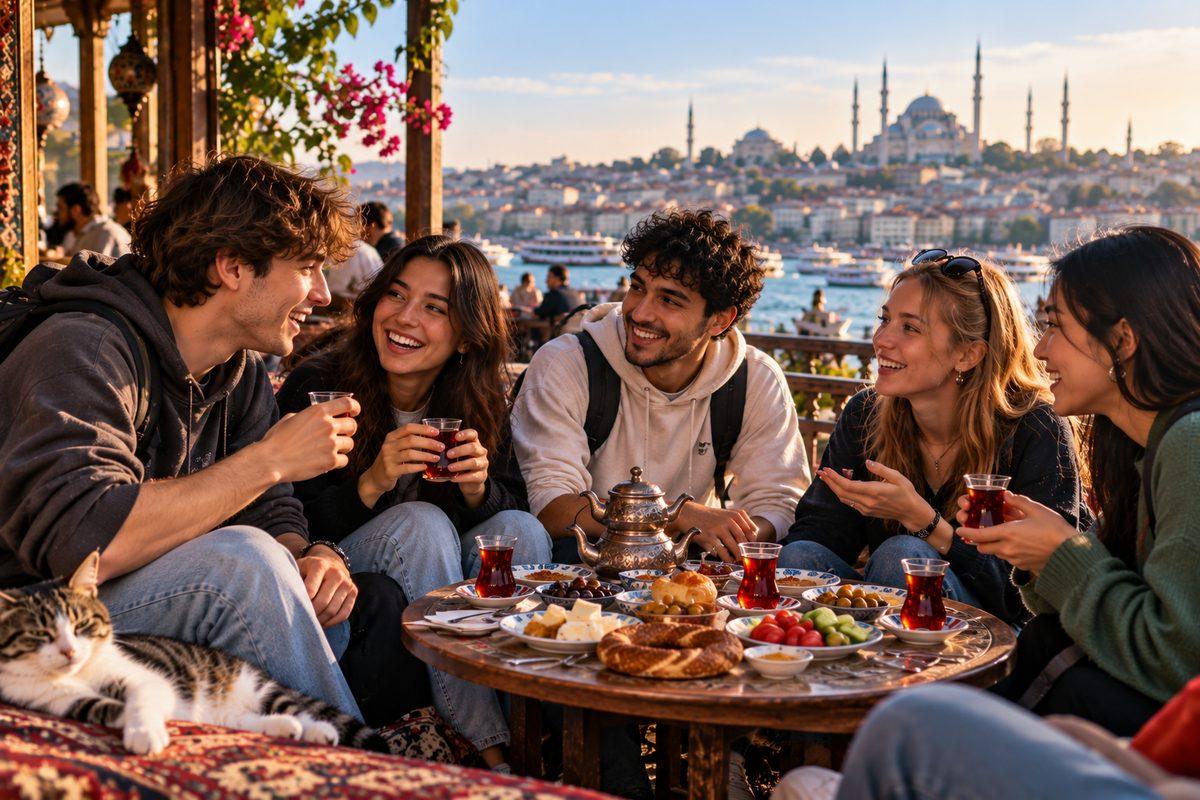
You’ll be offered tea everywhere: at university, in shops, at someone’s home, while waiting for something and occasionally while you’re trying to leave.
Tea isn’t just a drink here. It’s part of social life and hospitality.
You can always politely say no. Just don’t be surprised if the response is:
“Coffee?”
🍳 Turkish Breakfast Is Not Just Breakfast
A proper Turkish breakfast can involve cheese, olives, eggs, tomatoes, cucumber, bread, jams, honey and enough tea to keep the table occupied for quite a while.
If someone invites you for kahvaltı, don’t necessarily think of it as grabbing something quickly before class.
Breakfast can be a social event in itself.
And maybe don’t schedule lunch immediately afterwards.
👨🏫 Everyone at University Is “Hocam”
At university, you’ll hear hocam everywhere.
It’s a common respectful way students address lecturers and professors rather than constantly using formal academic titles.
You’ll also hear abi and abla in everyday life. Literally “older brother” and “older sister,” they’re often used as friendly or respectful ways of addressing someone older.
Don’t worry about forcing these expressions. Listen to how people around you use them and you’ll pick them up naturally.
🗣️ A Few Turkish Phrases Go a Long Way
You don’t need hundreds of words to start interacting in Turkish. A handful will get you surprisingly far:
Merhaba — Hello
Lütfen — Please
Teşekkürler — Thank you
Hoş geldin — Welcome
Hoş bulduk — The traditional response to “welcome”
Kolay gelsin — Said to someone who’s working
Afiyet olsun — Enjoy your meal
Eline sağlık — Thanks / well done, especially for something someone made or cooked
Geçmiş olsun — Get well soon / hope it passes
Anlamadım — I didn’t understand
Görüşürüz — See you
Some don’t translate perfectly into English, and that’s part of what makes them interesting.
You’ll hear expressions such as kolay gelsin, afiyet olsun and geçmiş olsun all the time. Start using them yourself and you’ll quickly understand how much these small phrases are part of everyday social life.
🍴 Don’t Be Surprised If Food Keeps Appearing
If you’re invited into a Turkish home, don’t be surprised if food keeps appearing.
Then tea.
Then fruit.
Then possibly something else you didn’t realize was coming.
You don’t have to finish everything, but showing appreciation goes a long way.
And if you casually mention that you’ve never tried a particular Turkish dish, there’s a reasonable chance someone will decide this situation needs correcting immediately.
👟 Look Down When You Enter Someone’s Home
In many Turkish homes, shoes come off at the entrance.
If you’re unsure, look at what everyone else is doing or simply ask. You may be offered slippers.
This is also when you’ll discover whether choosing your socks that morning deserved more consideration.
🎁 Don’t Arrive Empty-Handed
If a Turkish friend invites you to their family home, bringing something small can be a nice gesture.
Dessert, chocolates or another simple treat is usually enough. It doesn’t need to be expensive — the gesture matters more than the price.
There’s also a reasonable chance whatever you bring will eventually appear on the table alongside considerably more food than you expected.
🤝 Greetings Can Feel Warmer
Depending on the people and situation, greetings between friends may involve handshakes, hugs or cheek kisses.
There’s no complicated system you need to memorize.
Follow the other person’s lead.
Personal habits vary by person, family, generation and social circle — especially among younger people and international groups.
💬 Personal Questions May Arrive Quickly
Where are you from? How old are you? Are you married? Do you have a boyfriend or girlfriend? What do you think about Türkiye?
Depending on your culture, some questions may feel surprisingly direct.
Often they’re simply part of getting to know someone or starting a conversation.
That doesn’t mean you have to answer anything you’re uncomfortable discussing.
💸 The Bill Can Become a Negotiation
Sometimes you’ll see people competing to pay the bill.
Someone grabs it. Someone else protests. A third person tries to hand over money.
This isn’t a rule — and groups of students will often simply split expenses — but treating someone can be part of hospitality and friendship.
If someone genuinely wants to pay, say thank you.
You can always get the next one.
🐈 Yes, The Cats Basically Live Here Too
One of the first things many newcomers notice is how visible street cats — and dogs — are around Istanbul.
You’ll see water bowls outside shops, food left out for animals and cats sleeping in cafés, gardens and university campuses as if they own the place.
You’ll probably photograph them constantly during your first month.
By month four, you’ll be moving your backpack because a cat has apparently decided the chair belongs to him.
🍴 Turkish Food Is Much Bigger Than Döner
If your experience of Turkish food begins and ends with döner, you’ve barely started.
Türkiye has enormous regional food diversity.
Ask someone from Gaziantep, Adana, Hatay, Trabzon, İzmir or another part of the country what food their hometown does best.
Then stand back.
You may have accidentally started a national debate.
Exploring regional food is also one of the easiest — and tastiest — ways to discover that Türkiye isn’t one single culture or cuisine.
⚽ Football Can Get Serious
Galatasaray, Fenerbahçe and Beşiktaş aren’t simply football teams to many supporters.
You’ll notice.
Especially on derby night.
You don’t need to follow football, but club identity is an important part of Istanbul life for plenty of people.
And if you decide to ask which team is best...
You created the problem yourself.
🇹🇷 Istanbul Is Not All of Türkiye
This one matters.
Spending one semester in Istanbul doesn’t make anyone an expert on Türkiye.
Istanbul is enormous and diverse, but it still has its own rhythm, history and culture.
Travel when you can. Talk to classmates from different parts of the country. Ask where they’re from, what people eat there, what their city is like and what they think visitors misunderstand about it.
Türkiye is much bigger than the city you’re studying in.
🇹🇷 You’ll See Atatürk Everywhere
You’ll see the Turkish flag and images of Mustafa Kemal Atatürk, founder and first president of the Republic of Türkiye, throughout public life — including universities, public institutions, businesses and public spaces.
If you’re spending a semester here, learning a little about Atatürk and the founding of the Republic will help you understand many of the references, commemorations and symbols you’ll encounter.
You don’t need to arrive knowing Turkish history.
Be curious, ask questions and be respectful.
🔤 Turkish Isn’t as Impossible as It Looks
Turkish uses a Latin-based alphabet with a few letters you may not know.
Ç sounds like ch and Ş like sh. Ö and Ü will already look familiar to many European students.
Then you meet the dotless ı and the famous ğ — yumuşak g.
Don’t worry about perfect pronunciation.
Learning how to pronounce your classmates’ names correctly is already a pretty good place to start.
And yes, you can survive much of Erasmus in Istanbul using English.
But survival isn’t really the point.
Try some Turkish. Nobody expects perfection.
🌍 Don’t Judge Every Difference
Living abroad means constantly encountering things that aren’t done the way they’re done back home.
Some you’ll love. Some will annoy you. Some won’t make any sense for months.
You don’t have to decide that every difference is better or worse.
Sometimes the most useful reaction is simply:
“Oh. They do this differently here.”
Observe. Ask. Learn.
That’s part of Erasmus too.
❤️ Then One Day You Stop Thinking About It
At first, you notice every cultural difference.
Then, without really realizing it, you start adapting.
You say kolay gelsin naturally. You know when to take your shoes off. You pronounce your classmates’ names properly. You order tea without thinking about it.
Then someone visits Istanbul and suddenly you’re the one explaining how things work.
That’s one of the best parts of Erasmus.
You didn’t just come to Türkiye and look around.
A little bit of Türkiye came home with you. 🇹🇷❤️
Sound like your kind of Istanbul?
Smileys is where people here meet in real life — dinners, walks, clubs. Small, curated, no feed to scroll.