Hidden Istanbul: The Secret World of Kuzguncuk
Churches, a synagogue and mosques side by side, a haunted mansion and a saved garden: discover Kuzguncuk, Istanbul's Bosphorus village.
Nate
Published 11 November 2026 · 👁 71 views
Most of Istanbul announces itself. Kuzguncuk whispers. A short ride up the Asian shore from Üsküdar, a narrow valley opens onto the Bosphorus, and a single tree-lined street, İcadiye Caddesi, climbs gently away from the water.
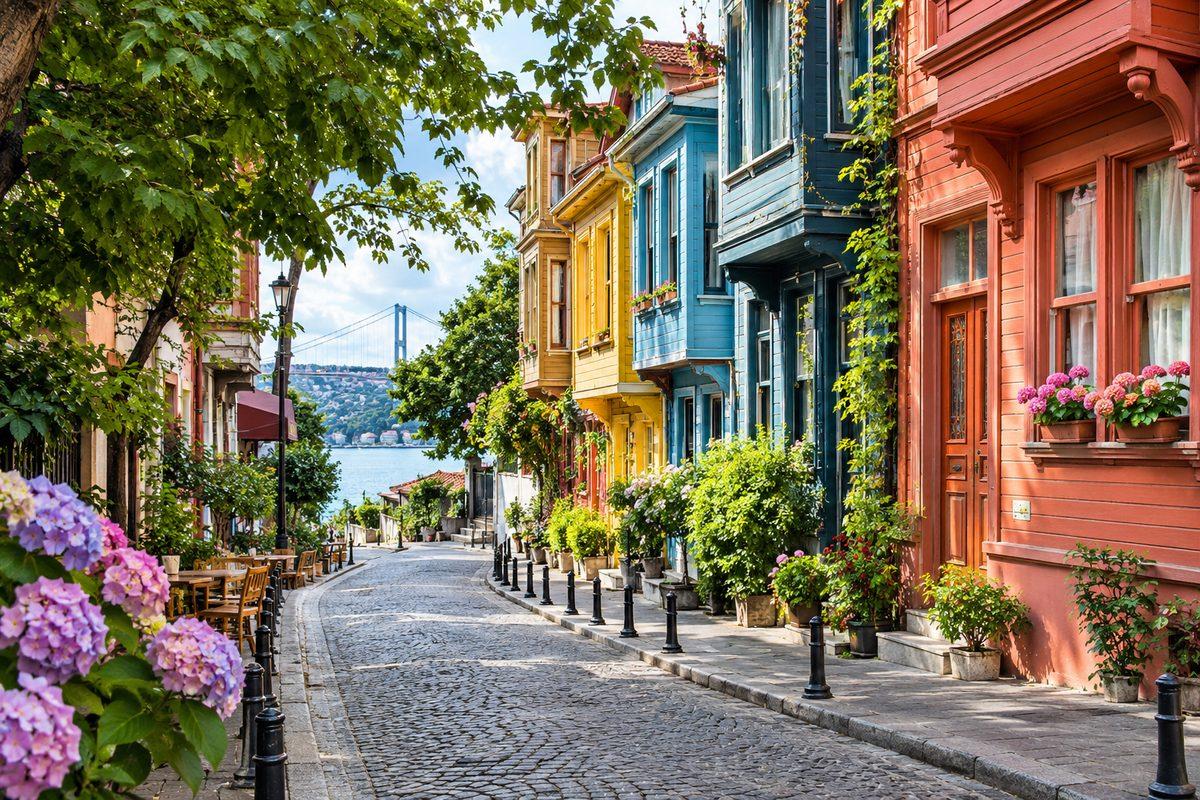
Wooden houses in mustard, rust and sea-green lean over the side lanes. Cats doze on doorsteps, a bakery sends warm bread into the street, and ferries slide past at the bottom of the hill.
It feels like a village because, for most of its history, it was one. What makes it remarkable is who lived here. Within a few hundred metres stand two Greek Orthodox churches, an Armenian church, a working synagogue and two mosques. Their story is no simple fairy tale of harmony, and it is more interesting for that.
Four communities, one valley
Start at the waterfront, opposite the ferry pier, at the Armenian church of Surp Krikor Lusavoriç, dedicated to Saint Gregory the Illuminator. A wooden church opened here in 1835 for an Armenian community that had been growing since the 18th century. The stone church you see today replaced it in 1861.
Right beside it is one of the neighbourhood's best stories. Until 1952, central Kuzguncuk had no mosque. When one was finally built, it went up in the churchyard, on land given by the Armenian congregation. Today the domes of the Kuzguncuk Mosque and the church rise side by side, at the same height.
Walk up İcadiye Caddesi and the layers keep coming. Beth Yaakov Synagogue, built in 1878, still carries Hebrew lettering above its doors. Jewish families were among Kuzguncuk's earliest Ottoman-era residents: the oldest dated gravestone in the hillside cemetery at Nakkaştepe goes back to 1562. Most have long since moved away, but descendants still return for Saturday services. A second synagogue, Bet Nisim, from the 1840s, no longer holds regular services.
Beside Beth Yaakov is the small Greek Orthodox church of Ayios Georgios (Saint George), whose origins are uncertain. Further up, behind a marble gateway and a bell tower added in 1911, stands Kuzguncuk's grandest church, Ayios Panteleimon. A church opened here in 1831; after a fire in the early 1870s, the present building was completed in 1892. Beside it is an ayazma, a holy spring of the kind Orthodox Christians have venerated around Istanbul for centuries.
At the northern edge of the neighbourhood, on the shore road towards Beylerbeyi, sits the little Üryanizade Mosque. It began life in 1860 as a mescit, a small prayer house, built by a leading family of Ottoman religious scholars. With its slender wooden minaret and the Bosphorus at its door, it is one of the most photogenic small mosques on the strait.
A name nobody can agree on
Kuzguncuk means "little raven" in Turkish, but nobody is sure why. The 17th-century traveller Evliya Çelebi credited a holy man called Kuzgun Baba, said to have settled here in the time of Mehmed the Conqueror. Others see a Turkish twist on the Byzantine-era name Kosinitza. An older tradition calls the area Chrysokeramos, "golden tile", after a church roof said to glitter with gilded tiles. None of these has been proven.
The mansion with a reputation
Follow the shore road towards Beylerbeyi and look up the slope. Half-hidden in the trees is a white wooden mansion with a small tower: the Cemil Molla Köşkü. It was built in the late 1880s for Cemil Molla, grandson of the man behind the Üryanizade Mosque and later Minister of Justice. His home became a salon of poetry, philosophy and music, and is said to have been among the first houses outside the palace with a telephone and electric light.
Then the story darkens. Cemil Molla died in 1941, and the house was sold a few years later. According to local accounts, misfortune followed: the new owner's son died in a car accident, the father soon after, and the widow moved out into a smaller building in the garden. Neighbours whispered that Cemil Molla's ghost walked the grounds, and for decades the mansion stood empty. There is no evidence of any haunting, but the legend stuck.
Restored in 2004–05, it is now private offices, so admire it from the road. Down on the water, the shore towards Üsküdar is lined with yalıs, the Bosphorus's wooden waterfront mansions, among them the Fethi Ahmet Paşa Yalısı, often called one of the finest on the strait.
When the street came out for Saint Panteleimon
Every 27 July, the Orthodox Church honours Saint Panteleimon, a healer saint. In Kuzguncuk the day once brought a panayır, a festival fair. A Jewish resident who grew up here recalled İcadiye Caddesi hung with flags, with singing and dancing to a barrel organ. The fair faded with the community that kept it, but the feast is still celebrated in the church, drawing worshippers from across the city.
The forgotten stream
Kuzguncuk lies in a small valley, and a stream once ran down it to the Bosphorus. It has long vanished from view, but street names such as Dereboyu, "along the stream", still remember it. Walking up İcadiye Caddesi, you are following the valley floor.
Built from the ashes
Wooden Istanbul lived in fear of fire. According to the Istanbul Fire Brigade's historical records, a fire in 1873 destroyed 591 buildings in Kuzguncuk. Another, in 1911, burned 68 more.
That is why many wooden houses here are younger than they look. Much of the neighbourhood was rebuilt in the decades after these disasters: two- and three-storey houses with narrow fronts, carved brackets and the cumba, a projecting bay window. Look up as you walk. A cumba let residents watch the street, catch the breeze and win extra room above a narrow lane.
September 1955, and after
Kuzguncuk's reputation for coexistence is real, but it is not the whole story. On the night of 6–7 September 1955, after a newspaper falsely claimed that Greeks had bombed Atatürk's birthplace in Thessaloniki, mobs attacked Greek-owned homes, shops, churches, schools and cemeteries across Istanbul. Official figures counted more than 4,000 homes and 73 churches damaged or destroyed. Kuzguncuk was among the neighbourhoods the violence reached.
The pogrom accelerated a departure that had already begun. Many Jewish families had left after the founding of Israel in 1948. In 1964, thousands of Greek nationals were expelled from Istanbul, and many Greek families with Turkish citizenship followed. Armenian families moved away too, and newcomers, many from the Black Sea region, settled in the houses left behind.
The churches and synagogue still stand, but their congregations are small. Remembering this does not cancel the neighbourly life people describe. It gives it its true weight.
The garden the neighbours saved
Just off İcadiye Caddesi lies Kuzguncuk Bostanı, a market garden of about 16,000 square metres, farmed for generations. Locals still call it İlya's garden, after a Greek gardener who sold its vegetables into the 1990s. When planning changes in 1986 opened it to building, residents fought for almost 30 years, including against a private school. A tense stand-off in 2014 ended in an agreement with the municipality to keep it green. Today it is a shared space of allotments, fruit trees and benches.
Higher up, Fethi Paşa Korusu (Fethi Pasha Grove) covers the hillside towards Sultantepe, with some of the best views of the Bosphorus Bridge.
Discover Kuzguncuk
Getting there: take the ferry or Marmaray to Üsküdar, then a short bus or minibus ride north along the shore, or walk it in about 25 minutes. A few commuter ferries stop at Kuzguncuk pier.
A walk of two to three hours:
- Surp Krikor Lusavoriç and the Kuzguncuk Mosque beside it.
- Up İcadiye Caddesi, past Beth Yaakov and Ayios Georgios.
- Ayios Panteleimon and its holy spring.
- The side streets and their wooden houses.
- Kuzguncuk Bostanı.
- A break at one of İcadiye Caddesi's independent cafés, Tarihi Kuzguncuk Fırını, the historic bakery, or İsmet Baba, a long-running fish restaurant by the pier.
- North along the shore to Üryanizade Mosque and the Cemil Molla mansion, or uphill to Fethi Paşa Grove.
Good to know: churches open mainly for services, Beth Yaakov visits must be arranged in advance through the Chief Rabbinate of Turkey, and the mansions are private. Dress modestly in places of worship and be discreet with your camera: this is a living neighbourhood, not an open-air museum.
More Hidden Istanbul: The Secret World of the Hans, the old trading inns behind the Grand Bazaar.
Walk it with us
Reading about Kuzguncuk is one thing; finding its stories on the street is another. Smileys Community is walking the neighbourhood together on Saturday, 14 November 2026, at 13:00, with Kaan as host.
Hidden Istanbul | Kuzguncuk – A Multicultural Heritage & Cultural Walking Tour
- Meeting point: Surp Krikor Lusavoriç Armenian Church, opposite Kuzguncuk pier
- Language: English
- Group size: maximum 10 participants
- Fee: 250 TL, paid in advance
View the event and reserve your place
Come curious, bring your camera, and meet fellow Istanbul explorers.
Comments