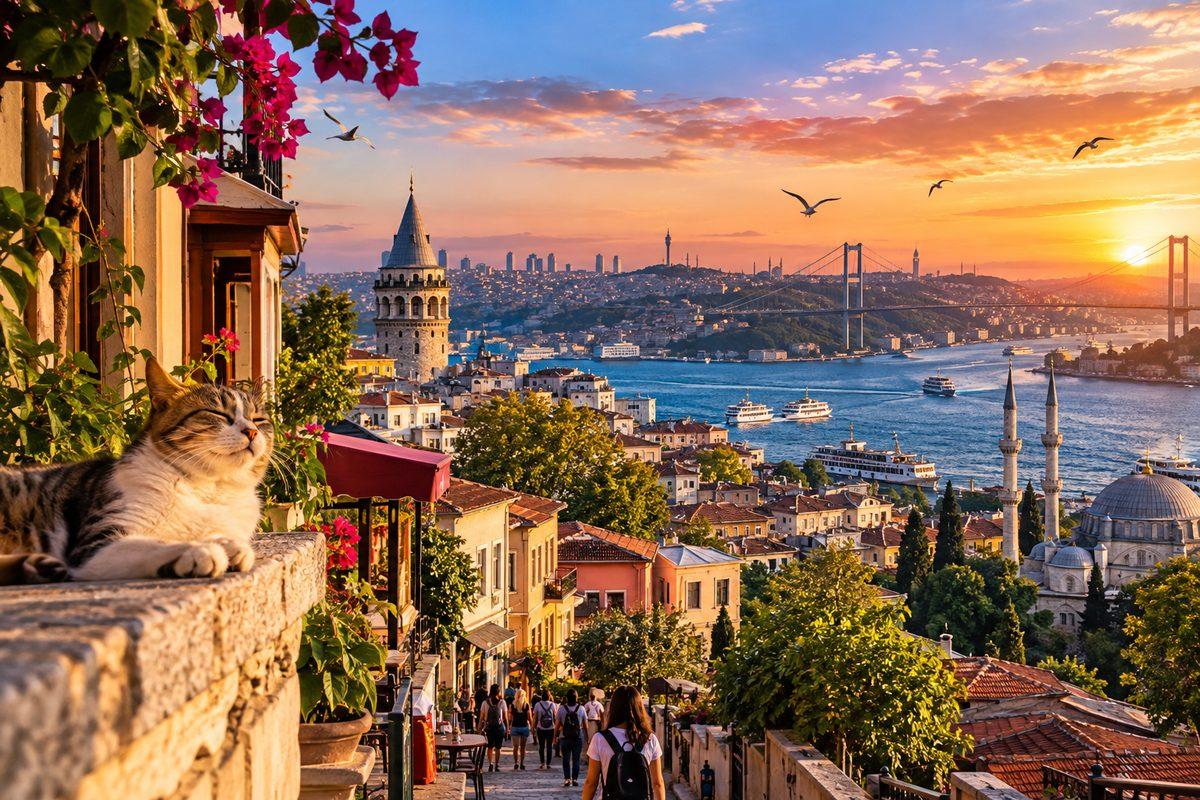
🤯 Things About Istanbul That Make No Sense Until You Live Here
Distances that lie, a city with several centers, a Bosphorus that shapes your weekend plans, and the minibus phrase worth learning — what Erasmus students usually figure out in their first weeks.
Nate
5 October 2026 · 👁 14 views
You’ve been in Istanbul for a few weeks. You’re getting the hang of the metro, you know a little Turkish, and you’ve stopped being surprised by cats sleeping in completely inappropriate places. Then something reminds you that the city is bigger than your mental map of it. Some things about Istanbul only start making sense once you actually live here, and these are the ones Erasmus students tend to run into first.
📍 Distance Doesn’t Tell You Anything
In most cities, five kilometers means a predictable journey. In Istanbul, it can be 15 minutes or well over an hour, depending on traffic, a bridge, a ferry, a hill or how many connections you need. With more than 15 million people (the official 2025 figure is about 15.75 million), the city is simply huge, and after a while you stop asking “How far is it?” and start asking “How long will it take?” Check the route in a maps app before you commit, and add a buffer when you have a class or an exam.
🗺️ There Isn’t One City Center
When someone says they’re “going to the center,” it’s fair to ask which one. Taksim and the rest of Beyoğlu feel like the center when you first arrive, but Istanbul works more like several cities that grew into each other. Kadıköy, Beşiktaş, Şişli, Üsküdar and Bakırköy all have their own shops, restaurants and nightlife, and plenty of people spend whole weeks without going near Taksim or Sultanahmet.
🌍 Which Side Are You On?
The Bosphorus separates the European side from the Asian side, and it becomes part of your everyday vocabulary faster than you’d expect. Plans get judged by it: “Which side?” is often the first question when someone suggests meeting up. You can cross by ferry, by Marmaray under the water, or by metrobüs and bus over the bridges, but crossing takes time, so staying on your own side for the evening is a perfectly reasonable decision.
🏘️ One Place, Several Names
The same area can be described in more than one way. People say Kadıköy, they say Moda, and an official address says Caferağa. These are layers of the same place: Kadıköy is the district, Caferağa is the official neighborhood (mahalle), and Moda is the part of it everyone actually calls by name. Beyoğlu, Taksim, Cihangir and Galata work the same way, and locals use them differently depending on who is talking. Once you stop relying only on official boundaries and learn how people describe places, your mental map improves quickly.
🧗 Maps Shows Hills, But Not How They Feel
A route can look like a pleasant 12-minute walk until a street turns into what feels like a ski slope. Beyoğlu, Cihangir, Galata, Beşiktaş and Üsküdar are all good at teaching this. Treat any “easy walk” on the map with some suspicion and check the elevation, or just pick shoes you can climb in.
🚦 Cross the Street Carefully
Cars, buses, motorcycles, scooters and pedestrians share the road, and a driver may not stop just because you’re at a crossing. Use marked crossings and pedestrian lights where you can, but don’t assume anyone has seen you. Look, then look again, even when the light is in your favor.
🚇 There’s Always Another Kind of Transport
You work out the metro, and then you meet the metrobüs, a bus rapid transit line with its own lane. Then Marmaray, ferries, regular buses, minibuses and the dolmuş. At some point someone will say “just take the dolmuş from there,” and you’ll nod without knowing what they mean. It does click eventually. One Istanbulkart works across most of the network, so the practical advice is to get one early and learn the system one line at a time. (We have a separate story on the student Istanbulkart.)
🚐 The Minibus Is Its Own Education
Your first minibus ride can feel mysterious. Where do you get on, how do you pay, and how does anyone know where to get off? Many minibuses and dolmuş still run on cash, and some now accept Istanbulkart, so it’s worth watching what other passengers do and asking when you’re unsure. Fares are usually based on your route. To get off, you tell the driver, and the phrase to know is “Müsait bir yerde” (or “müsait yerde indirir misiniz?”), which means “at a suitable place.” One day you’ll say it without rehearsing, and that counts as a small Istanbul milestone.
🏪 Your Local Shopkeeper Will Start Recognizing You
At first you’re just another customer. After a few weeks, the person at the market, bakery, café or corner shop starts to remember you, then says hello first, and may already know what you usually buy. In a city this size, a neighborhood can end up feeling surprisingly personal, and this is one of the quieter things visitors rarely notice.
🛵 Almost Everything Can Be Delivered
Food, groceries, drinking water and forgotten supermarket items are all a few taps away in Istanbul, and the convenience becomes a habit. Many students only realize how spoiled they’ve been when they get home after their exchange and discover that things no longer appear at the door on demand.
🏢 Apartment Life Has Its Own Rules
Sooner or later you’ll deal with a water cut, an internet problem, building maintenance or a notice taped near the entrance. Many buildings have a manager (yönetici), neighbors who know everything, and often a WhatsApp group that suddenly becomes the most important information service in Türkiye. You won’t understand every message, but when several neighbors write “Su yok mu?” (“Is there no water?”), you can guess what’s going on. If something affects your apartment, such as a leak or a rent question, ask your landlord or the building manager rather than guessing.
🐈 A Cat Can Interrupt Almost Anything
A café meeting, a queue, a lecture, a restaurant terrace: if a cat shows up, there’s a good chance everything pauses while someone says hello. Street cats are a real part of Istanbul life, and after a few months you’ll probably take part.
🥣 Soup at 2 AM Is Completely Reasonable
Soup isn’t only for lunch or sick days here. After a long night out, a bowl of mercimek çorbası (lentil soup) makes complete sense, and the traditional late-night choice is işkembe çorbası (tripe soup), served at places that stay open late. Your family back home may ask why you’re eating soup at that hour. You’ll have your answer.
📱 Addresses Are a Puzzle
A Turkish address can include a district, neighborhood, street, building number, apartment number and several words you haven’t met yet. In everyday conversation, the neighborhood is usually more useful than the district, and directions often end with a landmark such as “next to the pharmacy, opposite the bakery.” In time, the city becomes landmarks in your head instead of administrative boundaries.
🌦️ Weather Isn’t the Same Everywhere
If a friend on the other side of the city says it’s pouring, and you’re looking at sunshine, they’re probably not lying. Istanbul is large and sits between the Black Sea and the Sea of Marmara, so weather can differ noticeably from one part of the city to another. Check the forecast for the district you’re actually going to.
❤️ Then It Starts Making Sense
At first Istanbul feels enormous and confusing. Then you learn which metro exit to use, which minibus goes home, who runs your local shop and what the neighbors are talking about, and you understand that “close” doesn’t always mean quick. One day someone stops you on the street to ask for directions, and you actually know the answer. The city hasn’t become less chaotic. You’ve learned how to live in it, and that feels very different from visiting. 🇹🇷❤️
Sound like your kind of Istanbul?
Smileys is where people here meet in real life — dinners, walks, clubs. Small, curated, no feed to scroll.