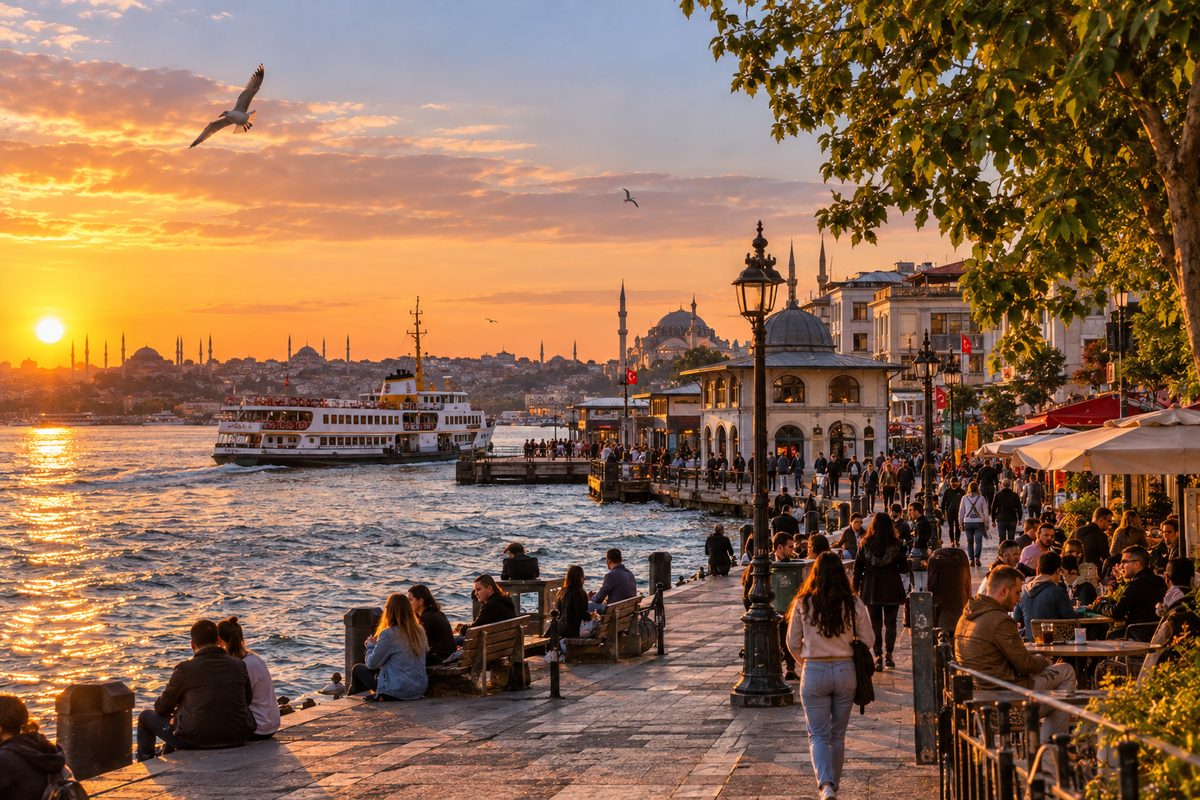
Kadıköy, Istanbul: What to Do, Where to Eat, and How to Get There
Kadıköy is Istanbul’s Asian-side hub — a busy ferry port surrounded by one of the city’s best food markets, historic neighbourhoods, independent shops, cafés, bars and a long waterfront stretching toward Moda. Come for the market, wander through Yeldeğirmeni, explore Bahariye, walk to Moda and stay until sunset. This is where you experience a different side of Istanbul.

Nate G.
18 September 2026 · 👁 22 views
What is Kadıköy?
Kadıköy is one of Istanbul’s largest and most lively districts on the Asian side of the city, facing the historic peninsula across the Sea of Marmara.
The central area is not one uniform neighbourhood. It is a collection of distinct areas, each with its own personality:
Kadıköy Çarşı — the market and food centre
Rasimpaşa / Yeldeğirmeni — historic buildings, street art and a creative atmosphere
Osmanağa — busy central streets, shops and everyday Kadıköy life
Bahariye — pedestrian streets, shops, cafés and the nostalgic tram
Caferağa / Moda — quieter streets, cafés and the waterfront
Kadife Sokak — bars, nightlife and live music
That variety is what makes Kadıköy interesting.
You can arrive by ferry, walk through a hundred-year-old market, discover enormous murals, browse second-hand records, have lunch at a traditional restaurant, walk beside the Marmara and finish the night at a bar — all without leaving the district.
Kadıköy also has a much deeper history than its contemporary reputation suggests. The area was ancient Chalcedon, a settlement established centuries before Constantinople became the centre of the Byzantine world.
Today, however, you don’t come to Kadıköy primarily for ancient ruins.
You come to experience Istanbul as a living city.
How to get to Kadıköy
By ferry — the best way
If you’re coming from the European side, take the ferry.
Şehir Hatları currently operates regular services between Kadıköy and Eminönü/Karaköy, as well as services to Beşiktaş and other parts of Istanbul. Exact frequencies vary according to the route, day and time.
The ferry is more than transportation.
Sit outside if the weather is good. Watch the European skyline disappear behind you, keep an eye out for seagulls following the boat, and enjoy the approach to the Asian shore.
It’s one of the easiest ways to make the journey to Kadıköy part of the experience.
You can use an İstanbulkart on the city’s public transport network.
By Marmaray
Marmaray crosses underneath the Bosphorus and connects the European and Asian rail networks.
From the European side, Sirkeci connects to Ayrılık Çeşmesi, where you can change to the M4 or continue into the wider Asian-side rail network.
It’s particularly useful if you’re travelling from areas not conveniently served by a ferry.
The downside is obvious: you’re underground.
If you’re not in a hurry, take the ferry instead.
By metro
The M4 Kadıköy–Sabiha Gökçen Airport Metro runs from Kadıköy all the way to Sabiha Gökçen Airport.
The current line has 23 stations, is 33.5 km long and has a published journey time of approximately 52 minutes from one end to the other. It operates approximately from 06:00 to midnight.
For travellers flying through SAW, this makes Kadıköy a particularly convenient base.
Start at Kadıköy Çarşı
The first place to explore after getting off the ferry is Kadıköy Çarşı.
The market streets around the ferry terminal are packed with fishmongers, greengrocers, spice shops, bakeries, cafés, meyhanes and specialist food shops.
This is not a museum.
It’s a working neighbourhood market.
Walk slowly and let your appetite decide what happens next.
What to look for
The fish market
The streets around Güneşlibahçe Sokak are closely associated with Kadıköy’s fish market and seafood restaurants.
You’ll find fishmongers, meze, seafood restaurants and places where locals come for dinner.
Pickle shops
Look for the traditional turşucu shops.
Turkish pickle culture goes far beyond cucumbers. You’ll see cabbage, peppers, carrots, beetroot and mixed vegetables, often accompanied by a glass of pickle juice.
It’s one of the easiest cheap snacks to try while walking.
Cheese and olive shops
If you’re interested in Turkish food, spend some time looking at the cheese, olive and dried-food shops.
You’ll see far more variety than you normally encounter in a supermarket.
Sweets
Baklava, lokum and other Turkish sweets are everywhere.
Don’t automatically buy a large box. Try something first.
Eat in Kadıköy
Kadıköy is one of Istanbul’s best districts for eating, but don’t make the mistake of turning the visit into a restaurant checklist.
Some of the best experiences are small and spontaneous.
Çiya Sofrası
Çiya Sofrası is the obvious destination restaurant for visitors interested in Turkish regional cooking.
Chef Musa Dağdeviren built Çiya around dishes and traditions from different parts of Anatolia and the wider region rather than limiting the menu to familiar kebabs and meze.
If you’ve never eaten regional Turkish food beyond kebabs, this is the place to experiment.
Look at the daily dishes rather than ordering only what you already recognise.
Midye dolma
For something much cheaper, try midye dolma — mussels stuffed with seasoned rice and served with lemon.
You’ll see them throughout Kadıköy.
They’re messy, inexpensive and quintessentially Istanbul.
Meyhane dinner
For a longer evening, look for a traditional meyhane around the market.
Order several meze to share, add a main dish if you’re still hungry, and don’t rush.
Kadıköy is much better suited to a long dinner than a quick meal between attractions.
Yeldeğirmeni: Kadıköy’s Historic Creative Quarter
Don’t skip Yeldeğirmeni.
This is the biggest omission visitors make when they treat Kadıköy as nothing more than the market plus Moda.
Yeldeğirmeni sits within Rasimpaşa, one of Kadıköy’s historic neighbourhoods, between the central Kadıköy area and Haydarpaşa.
Kadıköy Municipality describes Rasimpaşa as one of the district’s historic neighbourhoods, with much of the area protected as an urban and historic conservation area. It is also particularly rich in registered historic buildings.
The neighbourhood has a very different character from both busy Kadıköy Çarşı and seaside Moda.
Expect:
Historic apartment buildings
Old churches and religious buildings
Street murals
Independent cafés
Small creative businesses
Art and cultural spaces
Narrow residential streets
A strong neighbourhood atmosphere
Yeldeğirmeni is where you should wander without a plan.
Why is it called Yeldeğirmeni?
The name literally means “windmill.”
Kadıköy Municipality’s historical material traces the name to four windmills built during the reign of Sultan Abdülhamid I in the late 18th century to supply flour for the Ottoman palace. The windmills have disappeared, but the name survived.
Yeldeğirmeni subsequently developed into one of Istanbul’s earliest apartment neighbourhoods and became home to a diverse population including Turks, Greeks, Armenians and Jews.
That multicultural history is still visible in the neighbourhood’s architecture.
Look for the murals
Yeldeğirmeni became particularly well known for its large-scale murals through Mural-Ist, the mural festival supported by Kadıköy Municipality.
The first festival was held in 2012, and during its early years 16 walls in Yeldeğirmeni were painted by seven Turkish and nine international artists.
The murals are scattered through the neighbourhood rather than concentrated in one gallery.
So walk.
Look around corners.
And look up.
Some of the biggest works are on the sides of apartment buildings.
Yeldeğirmeni Sanat
Another important stop is Yeldeğirmeni Sanat, a cultural centre operated by Kadıköy Municipality.
The building dates to 1895, when it was constructed as part of the Notre Dame du Rosaire church and school complex. After years of changing uses and a long period of neglect, the building was restored and reopened as Yeldeğirmeni Sanat in 2014. Today it hosts concerts and cultural events.
If you’re interested in architecture or music, check the current programme before visiting.
Haydarpaşa connection
Yeldeğirmeni also leads naturally toward Haydarpaşa and the waterfront.
The historic Haydarpaşa railway station and port area fall within Rasimpaşa.
The station itself has had a complicated recent history, so check current access arrangements before planning your visit specifically around the building.
Bahariye: Shops, Cafés and the T3 Tram
From Yeldeğirmeni, head back toward central Kadıköy and continue toward Bahariye Caddesi.
Bahariye is one of the district’s main pedestrian and shopping streets.
You’ll find clothing shops, cafés, bookstores, music businesses and plenty of everyday Istanbul activity.
The T3 Kadıköy–Moda nostalgic tram runs through Bahariye.
The line is 2.6 km long, has 11 stations and takes about 20 minutes for the full one-way ring. Current Metro İstanbul information lists service hours that vary by day, with peak frequency around 10 minutes.
Take it if you want the experience.
Walk it if you want to discover more.
Akmar Pasajı: Books and Records
If you’re interested in books or music, make a detour to Akmar Pasajı around Mühürdar.
The arcade is associated with Kadıköy’s long-running independent book and music scene.
You can browse:
Second-hand books
Turkish literature
Foreign-language books
Vinyl
CDs
Music memorabilia
Don’t rush through it.
Half the fun is finding something you weren’t looking for.
Moda: Kadıköy’s Seaside Neighbourhood
South of the central district, the streets gradually become quieter and more residential.
Then you reach the sea.
This is Moda.
Moda has its own personality — cafés, tea gardens, restaurants, old apartment buildings and one of the city’s most enjoyable coastal walks.
Rather than repeating everything here, use the dedicated guide:
→ Moda Neighborhood Guide
The Moda guide covers the waterfront, Moda Burnu, Barış Manço House, cafés, food and the neighbourhood’s quieter streets in much greater detail.
For the Kadıköy hub, the important thing to know is simple:
Kadıköy and Moda belong in the same itinerary.
Kadıköy’s Waterfront
Kadıköy’s waterfront stretches far beyond the central ferry terminal.
You can walk toward Moda, continue around the shoreline and, depending on how far you want to go, eventually reach the Fenerbahçe side.
The central waterfront is good for watching ferries and people.
Moda is better for sunset.
Further along, the shoreline becomes more residential and less tourist-oriented.
You don’t need to complete the entire coastline.
Pick a direction and walk.
Kadife Sokak: Kadıköy’s Bar Street
After dark, Kadıköy changes again.
Kadife Sokak, better known as Barlar Sokağı, is one of the district’s main nightlife areas.
You’ll find small bars, live music, clubs and late-night venues packed into the surrounding streets.
Some names worth knowing include:
Karga
A long-established Kadıköy bar with a multi-level interior and an alternative nightlife reputation.
Kadıköy Sahne
A live-music and performance venue in the wider Kadıköy nightlife area.
6:45 Trip Kadıköy
A later-night venue on Kadife Sokak with a stronger party atmosphere.
velvet Club
Another Kadife Sokak nightlife option.
Check individual event programmes before going — Kadıköy’s nightlife changes quickly and the same venue can feel completely different depending on the night.
Things to Do in Kadıköy
1. Take the ferry across the Bosphorus
Don’t treat the ferry as transportation.
Make it part of your day.
Arrive on the European side with enough time to stand outside, watch the skyline and enjoy the crossing.
Kadıköy feels different the moment you step off the boat.
2. Explore Kadıköy Çarşı
Give yourself at least an hour to wander the market.
Don’t follow Google Maps from one restaurant to another.
Explore the side streets.
Taste something.
Have tea.
Then decide what you want for lunch.
3. Discover Yeldeğirmeni
This should be on every first-time Kadıköy itinerary.
Walk through Rasimpaşa, find the murals, look at the old apartment buildings and visit Yeldeğirmeni Sanat if there is an event that interests you.
This is the part of Kadıköy many short tourist itineraries miss.
4. Ride the T3 tram
Take the nostalgic tram from Kadıköy through Bahariye and Moda and back toward Kadıköy.
The full route is only 2.6 km and takes around 20 minutes.
It’s more about the experience than getting somewhere.
5. Browse Akmar Pasajı
Spend some time looking through books, vinyl and music shops.
You might leave with something you didn’t know existed.
6. Walk to Moda
From the market, walk south rather than taking transport.
You’ll see the transition from busy commercial Kadıköy to residential Caferağa and eventually reach the sea.
Continue toward Moda Burnu for the sunset.
7. Watch a Fenerbahçe match
Kadıköy is home territory for Fenerbahçe, one of Turkey’s biggest football clubs.
Even if you don’t attend a match, the atmosphere around the district on match days can be intense and memorable.
If you’re travelling on a match day, expect heavier crowds and allow extra time for transport.
8. Take a ferry to the Princes’ Islands
Kadıköy also has direct ferry connections to the Princes’ Islands on some Şehir Hatları services.
Current schedules include Kadıköy stops on routes serving Kınalıada, Burgazada, Heybeliada and Büyükada, although services vary by day and season.
For a longer Istanbul stay, this can turn into an easy full-day escape from the city.
Where to Stay in Kadıköy
Kadıköy makes particular sense for travellers staying five nights or more.
You’re surrounded by restaurants and cafés, have strong public-transport connections and can reach the European side by ferry.
It also feels more residential than Sultanahmet.
But there is a trade-off.
If your entire trip is focused on Hagia Sophia, Topkapı Palace, the Blue Mosque, the Grand Bazaar and Galata, staying on the European side will usually reduce travel time.
Kadıköy is better suited to travellers who want to experience Istanbul rather than simply tour it.
Central Kadıköy
Stay around the ferry terminal and Çarşı if convenience is your priority.
You’re close to the market, ferries, metro, nightlife and restaurants.
Yeldeğirmeni
Choose Yeldeğirmeni if you want historic architecture, cafés, street art and a more creative neighbourhood atmosphere.
It’s particularly interesting for longer stays.
Moda
Moda is the choice if the waterfront, cafés, restaurants and relaxed atmosphere matter most.
See our dedicated Moda guide.
Further south
Kalamış and Fenerbahçe are quieter and more residential.
They make more sense for people prioritising space and local life over being in the centre of the action.
Is Kadıköy Worth Visiting on a Short Trip?
Yes — but don’t try to see everything.
Two days in Istanbul
Concentrate on the historic peninsula and visit Kadıköy for an evening.
Three days
Give Kadıköy at least half a day.
Market → Yeldeğirmeni → Moda → sunset.
Five days or more
Give Kadıköy a full day.
Or consider staying here.
That’s when the district becomes more than another item on your Istanbul itinerary.
A Perfect First Day in Kadıköy
10:00 — Arrive by ferry
Start the day with the crossing from the European side.
↓
10:30 — Kadıköy Çarşı
Explore the market and food streets.
↓
12:30 — Lunch
Try Çiya or choose a restaurant that catches your attention.
↓
14:00 — Yeldeğirmeni
Walk through Rasimpaşa and look for the murals.
↓
15:00 — Yeldeğirmeni Sanat
Check whether there is an exhibition or concert.
↓
16:00 — Bahariye
Walk toward Bahariye and explore the shops.
↓
17:00 — Akmar Pasajı
Browse books and records.
↓
18:00 — Moda
Continue south toward the waterfront.
↓
Sunset — Moda Burnu
Sit by the sea.
↓
20:30 — Dinner
Eat in Moda or return toward Kadıköy Çarşı.
↓
22:30 — Kadife Sokak
Finish the night with drinks or live music.
Practical Information
District: Kadıköy, Istanbul — Asian side.
Best arrival: Ferry from Eminönü, Karaköy or Beşiktaş.
Metro: M4 connects Kadıköy with Sabiha Gökçen Airport.
Nostalgic tram: T3 Kadıköy–Moda — 2.6 km, 11 stations, approximately 20 minutes.
How long: Half a day for the highlights; a full day for Kadıköy Çarşı, Yeldeğirmeni, Bahariye and Moda.
Best time: Start late morning and stay through sunset.
Best day: Weekdays are generally calmer. Friday and Saturday evenings are livelier.
Money: Cards are widely accepted, but carrying some Turkish lira is still useful for small purchases and older businesses.
Kadıköy FAQ
Is Kadıköy on the Asian or European side of Istanbul?
Kadıköy is on the Asian side of Istanbul, facing the historic European side across the Sea of Marmara.
Is Kadıköy worth visiting?
Absolutely. The market, Yeldeğirmeni, Bahariye, Moda, waterfront and nightlife offer a very different experience from Istanbul’s main historic attractions.
How do I get from Sultanahmet to Kadıköy?
One of the easiest options is to travel to Eminönü and take the ferry to Kadıköy. You can also use Istanbul’s rail network and connect to the M4.
How long is the ferry to Kadıköy?
It depends on the departure point and specific service. Don’t rely on a single fixed journey time; check the current Şehir Hatları timetable for your sailing. Current routes include Kadıköy–Karaköy–Eminönü and Kadıköy–Beşiktaş.
What is Kadıköy famous for?
Kadıköy is known for its food market, waterfront, cafés, nightlife, independent shops, music scene, Yeldeğirmeni, Moda and strong neighbourhood culture.
What is Yeldeğirmeni?
Yeldeğirmeni is a historic area within Rasimpaşa, known for its old buildings, multicultural history, murals, cafés and cultural venues. Kadıköy Municipality identifies Rasimpaşa as one of the district’s historic neighbourhoods and notes its concentration of registered historic buildings.
Is Yeldeğirmeni worth visiting?
Yes. If you want to understand Kadıköy beyond the market and Moda, it is one of the most interesting areas to explore.
Can I visit Kadıköy and Moda together?
Definitely. In fact, you should. Start at Kadıköy Çarşı, explore Yeldeğirmeni and Bahariye, then walk south through Caferağa to Moda.
Is Kadıköy good for nightlife?
Yes. Kadife Sokak and the surrounding streets have a large concentration of bars, live-music venues and late-night spots.
Can I take a ferry from Kadıköy to the Princes’ Islands?
Yes. Current Şehir Hatları schedules include Kadıköy on services to Kınalıada, Burgazada, Heybeliada and Büyükada, although schedules vary by day and service.
Is Kadıköy a good place to stay?
It can be an excellent base for longer stays, particularly if you prefer neighbourhood life, restaurants, cafés and ferry connections over being directly beside Istanbul’s major historic sights.
Planning Your Istanbul Trip?
Kadıköy is the hub.
Yeldeğirmeni gives you history and creativity.
Bahariye gives you shops and city life.
Moda gives you the sea.
Kadife Sokak gives you nightlife.
And the ferry gives you one of the best ways to see Istanbul itself.
→ Explore the Moda Neighborhood Guide
→ See Where to Stay in Istanbul
If you’re staying long enough, don’t just visit Kadıköy.
Spend a day here. Get lost a little. Eat something you can’t pronounce. Sit by the sea. Then decide whether you really want to go back to the tourist centre.
Ready to experience this?
Join Smileys and become part of the most vibrant social community in your city.