Beyoğlu, Istanbul: What to Do, Where to Eat and How to Get There
Plan a day in Beyoğlu: İstiklal Avenue, Galata Tower, Çukurcuma, the Karaköy waterfront, where to eat, nightlife and how to get there.
Nate
Published 25 October 2026 · 👁 26 views
Beyoğlu is the part of Istanbul’s European side that sits north of the Golden Horn: İstiklal Avenue, Galata Tower, the Karaköy waterfront and a cluster of hillside neighborhoods that each move at their own pace. This guide covers what to see, where to eat and drink, how to get there, and how to fit it all into one day without doubling back.
What to Do in Beyoğlu
Walk İstiklal Avenue
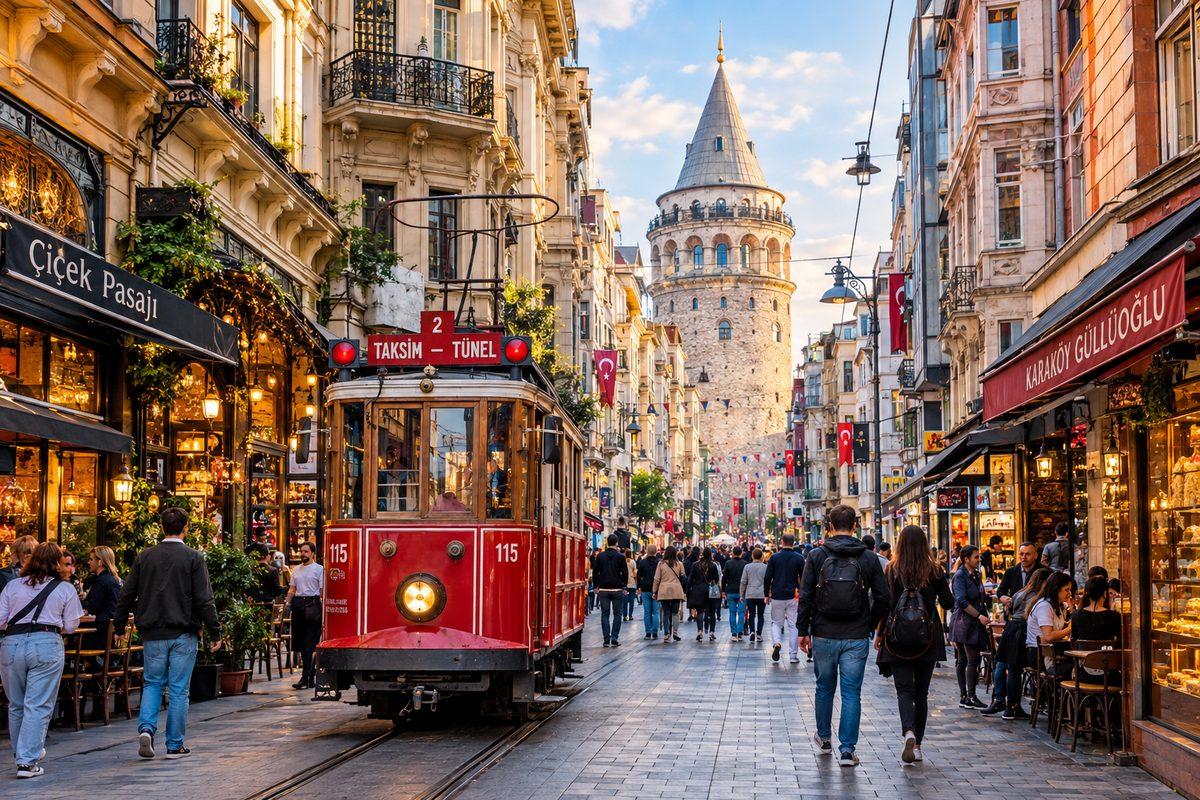
İstiklal Caddesi is the pedestrianized spine of Beyoğlu, running from Taksim Square in the north to Tünel Square in the south. Behind the chain stores you’ll find 19th-century façades, arcades, churches, cinemas and bookshops, so it pays to look up and step into the side passages. The red-and-white nostalgic tram (line T2) runs the length of the avenue; since 2024 the city has been adding battery-powered trams built in the same style, so check İETT for current service before you plan around it.
Visit St. Anthony of Padua Church
Set back from İstiklal behind a courtyard and a pair of matching apartment blocks, St. Anthony of Padua (Sent Antuan) is the largest Catholic church in Istanbul. The current red-brick, neo-Gothic building went up between 1906 and 1912 to designs by Giulio Mongeri, replacing an earlier church built by the city’s Italian community. Entry is free; Mass is held in several languages, so keep your voice down and avoid photographing worshippers during services.
Climb Galata Tower
Built by the Genoese in 1348 as part of Galata’s fortifications, the tower reopened as a state museum in 2020, with exhibitions inside and a panoramic terrace at the top. Queues can be long in high season. Check current hours and tickets on the Ministry of Culture and Tourism’s museum site, muze.gov.tr. Galata Tower accepts the Müzekart, so if you plan to visit several museums, read our guide to Istanbul’s museum cards.
See the Museums and Galleries
Pera Museum – a private museum opened in 2005 in the former Bristol Hotel, with Orientalist paintings, Anatolian weights and measures, Kütahya tiles and strong temporary exhibitions.
Galata Mevlevi House Museum – a Mevlevi (whirling dervish) lodge founded in 1491 at the top of Galip Dede Caddesi, just off Tünel Square. Sema ceremonies take place on scheduled dates only.
SALT Galata – the former Ottoman Bank headquarters on Bankalar Caddesi, designed by Alexandre Vallaury and completed in 1892, now home to exhibitions, a research library and the Ottoman Bank Museum.
Istanbul Modern – Türkiye’s first museum of modern and contemporary art, in a Renzo Piano building that opened on the Karaköy waterfront in 2023.
Browse Çukurcuma
Downhill from Galatasaray, Çukurcuma is Beyoğlu’s antiques quarter: small shops selling furniture, old photographs, ceramics and Ottoman-era odds and ends. It’s also home to Orhan Pamuk’s Museum of Innocence, opened in 2012 in a 19th-century house and built around his novel of the same name. A recent TV adaptation has brought long queues, so go early.
Wander Through Tomtom
Between İstiklal and the Tophane waterfront, Tomtom is a short walk from St. Anthony but feels far from the crowds. Along Tomtom Kaptan Sokağı you’ll pass the walls and gates of the Palais de France and the Palazzo di Venezia, reminders of the embassies that once filled this part of the city. The palaces aren’t open to the public, but the quiet, sloping lanes are worth the detour.
Spend the Evening on the Karaköy Waterfront
Karaköy is where Beyoğlu meets the water. The Galataport redevelopment has opened up a promenade along the Bosphorus, with Istanbul Modern at one end and views across to the Historic Peninsula. Nearby, Mimar Sinan’s Kılıç Ali Paşa Mosque (1578–80) once stood on the shoreline and now faces the cruise terminal. Come for sunset, then find dinner in the streets behind the ferry pier.
Where to Explore: Beyoğlu’s Different Neighborhoods
Beyoğlu is an official district (ilçe), but people also use the name loosely for İstiklal and the old quarter of Pera around it. Inside the district, some names are official neighborhoods (mahalle) and others are everyday area names with no matching boundary, so Taksim, Galata and Karaköy are not interchangeable with Beyoğlu or with each other. For more on how Istanbul’s place names work, see why one place can have three different names.
Taksim — the square and its surroundings at the north end of İstiklal. An area name, not an official neighborhood. Go for transport connections, the Atatürk Cultural Center (AKM) and a starting point.
İstiklal and Pera — the avenue and the 19th-century European quarter around it, historically called Pera. Go for walking, churches, arcades, cinemas and Pera Museum.
Cihangir — an official neighborhood on the slope east of Taksim. Go for cafés, a slower residential feel and glimpses of the Bosphorus.
Çukurcuma — the streets around Çukurcuma Caddesi, below Galatasaray. Go for antique shops and the Museum of Innocence.
Tomtom — an official neighborhood between İstiklal and Tophane. Go for quiet lanes and the historic French and Venetian palaces.
Asmalımescit — an official neighborhood near the Tünel end of İstiklal. Go for meyhanes and bars, with Pera Museum nearby.
Galata — the historic walled Genoese quarter around the tower, on the hill above the Golden Horn. Go for Galata Tower, steep lanes and the Mevlevi lodge.
Karaköy — the waterfront below Galata, historically part of the same port quarter. Go for Galataport, ferries, Istanbul Modern and food.
Tophane — the waterfront just east of Karaköy. Go for Kılıç Ali Paşa Mosque and the Galataport promenade.
In practice, locals give directions by these names rather than by official boundaries. “Meet me in Karaköy” means the streets around the ferry pier, not a line on a map.
Where to Eat in Beyoğlu
Beyoğlu covers everything from century-old lokantas to meyhanes and waterfront brunch spots. Where you eat depends mostly on which end of the district you’re in.
Traditional lunch near Taksim: Hacı Abdullah has served Ottoman and Turkish home-style cooking since 1888 and has been at its current address on Atıf Yılmaz Caddesi, beside the Ağa Mosque, since 1958. Expect slow-cooked lamb, vegetable dishes and its famous jars of fruit compote. It serves no alcohol, and most dishes are cooked in the morning, so lunch is the best time to go.
Meyhane dinners: Asmalımescit, near the Tünel end of İstiklal, and the Nevizade lanes behind the Balık Pazarı (fish market) near Galatasaray are the classic places for a long evening of meze, fish and rakı. Book ahead at weekends.
Coffee and brunch: Cihangir and the lanes around Galata Tower are full of independent cafés. Karaköy is the place for a long weekend brunch.
Baklava: Karaköy Güllüoğlu has been making baklava on Rıhtım Caddesi, near the ferry pier, since 1949. It’s busy from morning until late.
Çiçek Pasajı: the historic arcade off İstiklal is atmospheric, but it’s aimed squarely at visitors. Go for the building rather than the food.
Wherever you sit down, ask to see a menu with prices, and confirm the price of fish sold by weight before you order. Our guide to scams and tourist traps covers the other common ones.
Nightlife and Entertainment
Beyoğlu is still one of the city’s main places for a night out, though the scene is spread across several areas rather than concentrated on İstiklal itself.
Meyhanes: Asmalımescit and Nevizade are busiest from around dinner time, with music in some places and tables spilling into the lanes in warm weather.
Rooftop bars: Galata and Karaköy have plenty of terraces with views over the Golden Horn and the Bosphorus. Door policies and dress codes vary.
Live jazz: Nardis Jazz Club, in a side street at the foot of Galata Tower, has hosted concerts since 2002. Seating is limited, so reserve if you want a table near the stage.
Opera, concerts and theater: the rebuilt Atatürk Cultural Center (AKM) on Taksim Square reopened in October 2021 and hosts opera, ballet, concerts and talks.
Cinema: İstiklal’s historic Atlas cinema was restored and now hosts screenings and film festivals. More in our guide to Istanbul’s cinema scene.
İstiklal gets very crowded late on Friday and Saturday nights. Keep your phone and wallet close.
How to Get to Beyoğlu
Beyoğlu is easy to reach by rail and ferry. Which stop you choose depends on whether you want to start at the top of the hill (Taksim, İstiklal) or the bottom (Karaköy).
M2 metro (Yenikapı–Hacıosman): Taksim station for the north end of İstiklal; Şişhane for the Tünel end and Galata Tower; Haliç, on the Golden Horn Metro Bridge, for connections from the Historic Peninsula.
T1 tram (Kabataş–Bağcılar): Karaköy and Tophane stops, for arriving from Sultanahmet and Eminönü across the Galata Bridge.
F1 funicular: Kabataş to Taksim, from the Bosphorus shore up to Taksim Square.
F2 Tünel: Karaköy to Tünel Square, skipping the steep climb between Karaköy and the south end of İstiklal.
Ferries: Karaköy pier, for crossing from the Asian side, including Kadıköy.
The Tünel opened in 1875 and is one of the oldest underground railways in the world, second only to London’s. Its two stations sit at Karaköy and at the southern end of İstiklal, and the ride takes only a couple of minutes.
Pay with an İstanbulkart, which works on the metro, tram, funiculars, buses and city ferries. Taksim and Şişhane stations and the F1 funicular are sometimes closed at short notice by the governor’s office on days of planned demonstrations, so check Metro İstanbul before you set out. For the Tünel and the nostalgic tram, see İETT; for ferries, see Şehir Hatları.
A Simple One-Day Beyoğlu Itinerary
This route runs from Taksim at the top of the hill down to the Karaköy waterfront, so you walk mostly downhill and finish by the water at sunset.
Morning: Taksim and upper İstiklal. Start at Taksim Square and walk down İstiklal to Galatasaray while it’s still quiet.
Late morning: Çukurcuma. Turn downhill from Galatasaray into Çukurcuma for the antique shops and the Museum of Innocence.
Midday: Tomtom and St. Anthony. Wander through Tomtom’s lanes, then climb back up to İstiklal and visit St. Anthony of Padua.
Lunch: Asmalımescit. Continue toward the Tünel end and eat in the lanes of Asmalımescit.
Afternoon: museums. Visit Pera Museum, then the Galata Mevlevi House on Tünel Square. The Mevlevi lodge closes earlier than most museums, so check the time.
Late afternoon: Galata Tower. Walk down Galip Dede Caddesi to the tower, then continue downhill past SALT Galata on Bankalar Caddesi.
Sunset: Karaköy waterfront. Stroll the Galataport promenade, visit Istanbul Modern if there’s time before closing, and stop for baklava.
Evening. Have dinner in Karaköy, or take the Tünel back up for a meyhane in Asmalımescit or jazz in Galata.
If you’d rather start with coffee in Cihangir, walk there from Taksim and continue straight down into Çukurcuma, leaving upper İstiklal for the evening.
Practical Tips Before You Go
Best times to visit
Weekday mornings are the quietest time for İstiklal, Galata Tower and the Museum of Innocence.
Evenings and weekends are the busiest, especially on İstiklal and around the tower.
Spring and autumn are the most comfortable seasons for walking the hills. Summer afternoons can be hot on the slopes, while winter is a good time for museums and meyhanes.
Sunset is the time to be on the Karaköy waterfront.
Accessibility
İstiklal Avenue is pedestrianized, wide and relatively gently sloped, making it the easiest part of Beyoğlu to get around.
Galata, Cihangir, Çukurcuma and Tomtom are steep, with cobbles, stairs and uneven pavements.
Use the Tünel or the M2 metro to avoid the steepest climb between Karaköy and İstiklal. Check lift status with the operator before relying on it.
The Galataport promenade along the Karaköy waterfront is flat.
Galata Tower has lifts, but queues and narrow spaces can make it tiring. Check access details with the museum before you go.
Good to know
Get an İstanbulkart for all public transport.
When visiting a mosque, avoid prayer times, cover shoulders and knees, and women should bring a headscarf. See Turkish basics and etiquette for more.
Opening hours change between summer and winter, and many state museums close on certain days. Check official sites on the day.
Is Beyoğlu Worth Visiting?
Yes. In a single day you can go from a 14th-century Genoese tower and a dervish lodge founded in 1491 to Ottoman-era banks, Levantine churches and a contemporary art museum by the Bosphorus. Add the food, the meyhanes and the views, and Beyoğlu rewards both a first visit and a slow return. If you want to stay nearby, Where to Stay in Istanbul for a Short Visit compares Karaköy, Galata and Taksim.
If you’re heading to the Asian side next, the ferry from Karaköy is the easiest way across. Read our guide to Kadıköy, Istanbul: What to Do, Where to Eat and How to Get There.
Comments