 Everyday Life
Pet Ownership in Istanbul: A Practical Guide for Expats
by Nate
Published 5 November 2026 · 10 min read · 👁 9 views
Quick summary
Moving to Istanbul with a pet? Learn about import rules, PETVET registration, veterinarians, pet-friendly housing, transport, adoption and emergency care.
Istanbul is a very animal-aware city, and living here with a pet is entirely doable. The hard parts are the paperwork before you arrive and a few rules that differ from what you may be used to at home. Clinics, boarding, and emergency contacts are in our separate Istanbul Pet Resources Directory.
Bringing Your Pet to Türkiye
If you're starting from scratch, plan on about four months. That's our estimate from the steps below, not a legal minimum, and a pet with a valid test on record may need less. The Ministry of Agriculture's border veterinary page sets out this order for cats, dogs, and ferrets traveling with a passenger, and the order matters:
Microchip first. A rabies shot given before the chip does not count. The regulation specifies an ISO 11784/11785 chip, or you must supply a reader.
Rabies vaccination. It must be an inactivated or recombinant vaccine, and still valid when you travel.
Antibody blood test. Take the sample at least 30 days after the vaccination and use an EU-approved lab. The regulation and the certificate say the result must be at least 0.5 IU/ml, while the Ministry page says above 0.5, so talk to your vet if it's close.
Wait. The Ministry page asks for 90 days from the result of a first test. The regulation words this as a sample taken three months before travel, so plan around the longer reading.
Health certificate. The authority in your departure country issues it on the official Turkish form.
Keep your pet's passport or vaccination record with you too. A pet with a passing test on record, and vaccinations that never lapsed, doesn't need to repeat the test or the wait.
Two details to confirm before you book. The Ministry page says the certificate should be issued within two days before travel, while the form itself says it stays valid for four months. Follow the two-day instruction unless the office tells you otherwise. We also found no official list that excuses low-rabies countries from the blood test, so don't rely on an agent or forum saying yours is exempt. You can ask the Istanbul Airport veterinary office directly at istanbul.vskn@tarimorman.gov.tr or +90 212 471 42 45.
Limits. Customs allows two pets per passenger, duty-free, and the pet must travel with you. Officials can admit unvaccinated animals under three months old only on conditions the Ministry sets, so ask first.
Banned breeds. Law No. 5199 and a 2021 Ministry circular bar the entry of American Pit Bull Terriers, Japanese Tosas, Dogo Argentinos, Fila Brasileiros, American Staffordshire Terriers, and American Bullies, along with their crosses. This is a legal ban, not just an airline rule. The circular's exception covered only dogs owned before July 14, 2021, and sterilized and registered by January 14, 2022, so it won't help a dog arriving now. If your dog is a mix that could be mistaken for one of these, get an answer in writing before you travel.
If the papers are wrong, the regulation lets officials send your pet back or hold it in quarantine at your expense. As a last resort, an animal that can do neither can be destroyed without compensation. That's why the sequence deserves your full attention.
Microchipping and PETVET Registration
Owned cats and dogs in Türkiye must be microchipped and recorded in the national system, PETVET, with a pet passport issued. The regulation covers ferrets too, but recent deadline notices name only cats and dogs, so ferret owners should ask their directorate. An authorized vet or a district agriculture directorate does this. For a pet born here, the owner has up to six months from birth to apply. The deadline for existing cats and dogs passed on December 31, 2025. Since then, standard registration has been limited to pets up to six months old, and older pets are registered with a fine. A provincial governor’s office put that fine at ₺10,423 in 2026, so check the current amount with your district directorate.
If you arrived from abroad, the regulation gives owners of imported animals 60 days to register them and get a Turkish passport, using the import document and any existing passport. It doesn't spell out how this applies to a pet that came with its owner, and we couldn't confirm how the six-month limit and fine apply to an older pet arriving from abroad. Treat 60 days as your deadline, book a vet soon after landing, ask the directorate before you register, and bring proof of your entry date. Bring your passport, your residence permit if you have one, the certificate, and vaccination records. The Istanbul Provincial Directorate can answer questions on +90 216 468 21 00.
Finding a Veterinarian
Find a regular vet before you need one. Ask about English on the first call, as it varies from person to person even within one clinic. Ask for the likely cost before agreeing to tests. A clinic that advertises 24-hour opening may still have no surgeon or specialist on site overnight, so in an emergency, call on your way and describe the problem. Our directory lists what we've been able to confirm so far.
Renting an Apartment with Pets
Three separate things can affect you, and permission from one doesn't settle the others:
The landlord. Tell them early, and get any permission in writing.
The rental contract. Read it for a pet clause. Turkish lawyers don't all agree on how far a lease clause can be enforced, so don't sign one and assume it won't matter.
The building's management plan (yönetim planı). This can matter most. In a 2022 decision, the General Assembly of Civil Chambers of Türkiye's top appeals court enforced a plan's ban on cats and dogs against an owner, without first requiring proof of a nuisance. Two judges dissented. Plans are worded differently and outcomes depend on the facts, so don't assume a ban is either automatic or harmless.
Ask to see the plan before you sign or pay a deposit. If it restricts animals, or there's a dispute, speak to a Turkish lawyer. Our apartment hunting guide covers the rest of the search.
Everyday Life with Pets
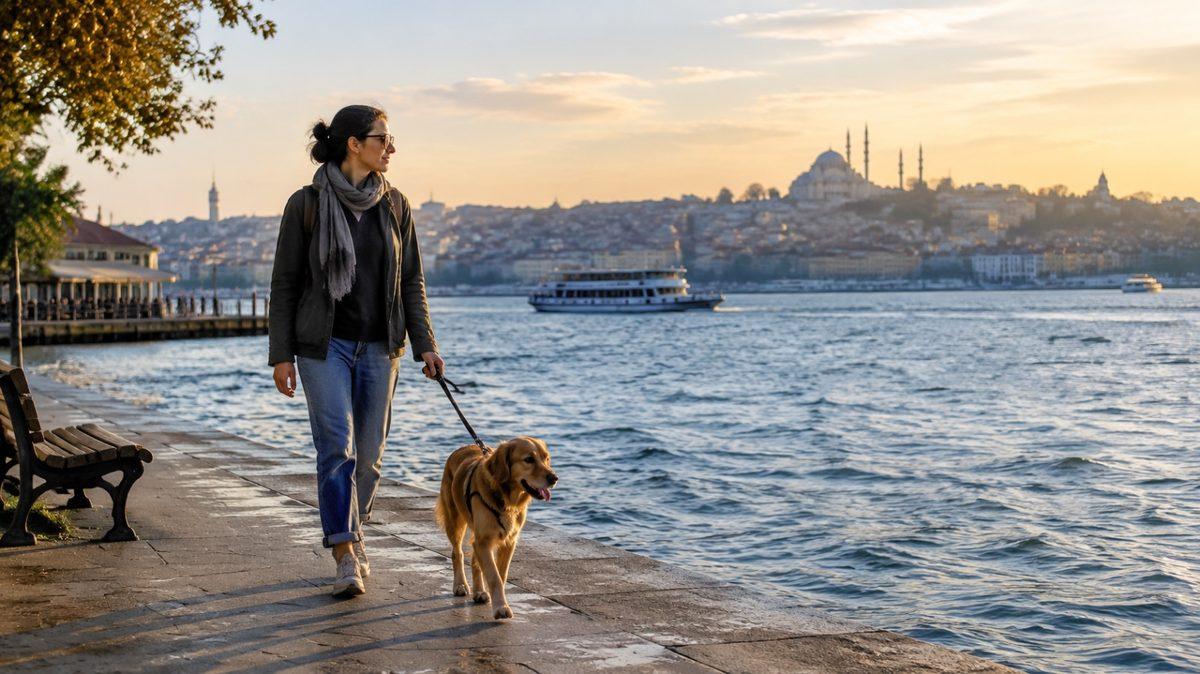
Keep dogs on a lead and carry bags, especially around street dogs, which can be territorial about their patch. The Moda and Caddebostan shorelines are popular for walks, but rules for individual parks vary, so check the signs. Summer pavement gets hot enough to hurt paws, so walk early or late. Ask your vet about tick and flea prevention, too.
For cats, the biggest risk is often the home itself. Falls from windows and balconies are a real risk, so fit secure screens or nets if you can. Keep your pet's ID and vaccination record handy, since authorities can ask to see it.
Traveling Around Istanbul with Your Pet
The rules differ by operator, and staff decide at the gate, so carry a muzzle even if you think you won't need one.
Metro Istanbul: Small dogs (up to 5 kg, carried on your lap, lead no longer than 50 cm) can travel at any time without a muzzle. Larger dogs need a muzzle and the same short lead, and can't travel from 7 to 10 a.m. or 4 to 8 p.m. It's one dog per passenger, and staff can refuse dogs when the system is unusually busy.
İETT buses and Metrobus: The size and hour rules are the same as the metro. Dogs and carriers aren't allowed on seats.
Şehir Hatları ferries: Dogs of any size can board at any time, but all of them need a muzzle and a lead no longer than 50 cm. That includes small dogs.
Marmaray: We couldn't find a current official rule. Passengers report inconsistent treatment, including refusals for small dogs without a carrier, so bring a carrier and allow time for another route.
On the metro, buses, and ferries, cats must be in a proper pet carrier, not a tote or backpack, and small pet birds in a cage. With taxis, ask the driver before you get in.
Street Animals, Adoption and Animal Welfare
Street cats and dogs are part of daily life here, and how to manage them is a contested public issue. A 2024 amendment to the animal protection law changed what municipalities must do: they take stray animals to shelters for care and treatment, and rehabilitated dogs stay there until adopted. It remains widely debated.
For an injured street animal, contact the municipality's ALO 153 line or your district's veterinary department. Hours and response times vary, so be ready to wait or to take the animal to a clinic yourself if you can. To report cruelty, the animal rights federation HAYTAP points people to 112 and the Interior Ministry's HAYDİ app.
If you'd like to adopt, start with a municipal shelter or an established group, as listed in the directory. Ask for the adoption certificate, microchip details, vaccination history, and PETVET information. If the animal isn't registered yet, ask the shelter or your district directorate to arrange it. A 2022 Ministry notice says an animal adopted from the street can be chipped and registered this way without a fine. Then have your own vet do a full check.
Lost Pets and Holiday Care
If your pet goes missing, report it to your provincial or district agriculture directorate, so it's marked as lost in PETVET. The same Ministry notice gives owners seven days. Then call nearby clinics and your district's veterinary department. Put up posters in Turkish and tell your building's kapıcı and neighborhood shopkeepers, who often notice everything. Keep your phone number current on the record, too.
Before you book boarding, visit in person and ask what happens in a medical emergency. Leave your vet's number, written permission for treatment, and a spending limit.
Pet Insurance and Veterinary Costs
Pet insurance is available from some providers in Türkiye, but cover varies widely, so read the exclusions and the annual limit before you buy. Many owners pay as they go. Prices differ considerably between clinics, and night visits often cost more, so it's worth keeping a small emergency fund and asking for an estimate up front. We're not listing prices here, because they change too quickly to stay accurate.
Preparing for an Earthquake or Emergency
Add your pet to your household plan, which our earthquake guide explains. Keep a carrier near the door, a few days of food and water, any medication, and photos of your pet with you in them. Save copies of the passport and microchip number on your phone. Agree on who can collect your pet if you can't get home, and don't assume every temporary shelter will accept animals.
Leaving Türkiye with Your Pet
Allow at least six months, which is how far ahead the regulation tells owners to check the destination's rules. Ministry guidance requires the chip, PETVET registration, and pet passport first, then the vaccination. A blood sample follows at least 30 days later, going to a Ministry-approved lab. Sending samples abroad needs permission.
EU countries: The Ministry says the health certificate can be issued three months after the blood sample.
Elsewhere: Requirements vary widely, including for the US and UK, and some countries have their own certificates, so ask your provincial or district directorate early.
Native breeds: Kangal, Akbaş, and Kars shepherd dogs, Çatal Burun and Zağar dogs, and Ankara and Van cats are protected, and passenger exit needs advance permission from the provincial directorate. This can catch people who adopted locally.
Airlines add rules of their own. Turkish Airlines, for example, currently won't carry pets on any route ending in the UK, including connections.
Your Istanbul Pet Owner Checklist
Chip, vaccinate, test, and wait, in that order, before you travel.
Register with PETVET and get a Turkish pet passport soon after you arrive.
Check the landlord, the lease, and the management plan before paying a deposit.
Choose a regular vet, and save a 24-hour clinic near you.
Buy a muzzle, a short lead, and a proper carrier for public transport.
Pack an emergency kit and keep digital copies of your pet's papers.
Final Thoughts
The first few months take the most effort. Once the paperwork is done and you've found a vet you trust, day-to-day life with a pet here settles down quickly, and a dog on the shore path is a great way to get to know your neighbors. If you spot a rule that has changed, please let us know so we can correct it for the next person.
Rules last checked: November 5, 2026. Requirements change, so confirm anything time-critical with the office named in each section. This guide is general information, not legal or veterinary advice.
Sources
Verify the current rules yourself — where they come from.
- Ministry of Agriculture: Istanbul Airport veterinary border office, travel with cats, dogs and ferretsvskn.tarimorman.gov.tr
- Regulation on non-commercial movement of pets (Official Gazette, 2011)resmigazete.gov.tr
- Ministry of Trade: passengers bringing animalsticaret.gov.tr
- Metro Istanbul travel rulesmetro.istanbul
- İETT passenger rightsiett.istanbul
- Şehir Hatları FAQsehirhatlari.istanbul
+ 6 more sourcesShow fewer
- Istanbul Provincial Directorate of Agriculture and Forestryistanbul.tarimorman.gov.tr
- Official circular on dangerous dog breeds (2021)tarimorman.gov.tr
- Isparta Provincial Directorate: identification deadlineisparta.tarimorman.gov.tr
- Identification regulation amendments (Lexpera)lexpera.com.tr
- Ministry notice on digital identification (Eskişehir, 2022)eskisehir.tarimorman.gov.tr
- HAYDİ app (General Directorate of Security)apps.apple.com
Quick links for this topic
Practical everyday links — curated by the Smileys team.
💬
Got a tip or a twist your case taught you?
Tell us and we'll fold it into the article, with credit.
More in Everyday Life
Istanbul Pet Resources Directory
Find veterinary clinics, emergency animal hospitals, pet sitters, boarding services and municipal animal-care resources in Istanbul.
Family Life in Istanbul: Raising children with confidence
Moving to Istanbul with children brings a new set of questions. How do you choose a school? What’s the difference between a kreş and an anaokulu? The good news is that thousands of Turkish and international families successfully raise children in Istanbul. The city offers excellent healthcare, a wide choice of schools, plenty of parks, and countless family-friendly activities. This guide explains what you need to know to help your family settle into everyday life.
Daily Life in Istanbul: The little things that make a big difference
Moving to Istanbul isn’t difficult—it just takes a little getting used to. Finding an apartment, setting up utilities, buying groceries, paying bills, ordering food, dealing with deliveries… none of these are especially complicated on their own. It’s the hundreds of little things that slowly wear you down until they become second nature. This guide covers the practical side of everyday life so you can spend less time figuring things out and more time enjoying Istanbul.