Hadrian's Gate, Antalya: The Complete Visitor's Guide
Hadrian's Gate, or Üç Kapılar ("Three Gates"), is one of Antalya's best-preserved Roman monuments. Built in AD 130 in honour of Emperor Hadrian's visit to the ancient city of Attaleia, the monumental marble gateway now marks one of the main entrances to Kaleiçi, Antalya's historic old town. It's free to see and takes only 20–30 minutes, but it makes an excellent starting point for a longer walk through Kaleiçi and down to the old harbour.

Nate G.
18 September 2026 · 👁 13 views
What is Hadrian's Gate?
Hadrian's Gate is a monumental Roman gateway built in AD 130, when Emperor Hadrian visited Attaleia. It formed an important entrance through the city's walls and was primarily a monumental and ceremonial structure rather than a defensive gate. The Antalya Metropolitan Municipality describes it as an important entrance and exit point for the ancient city, with roads leading toward places including Perge, Aspendos and Side.
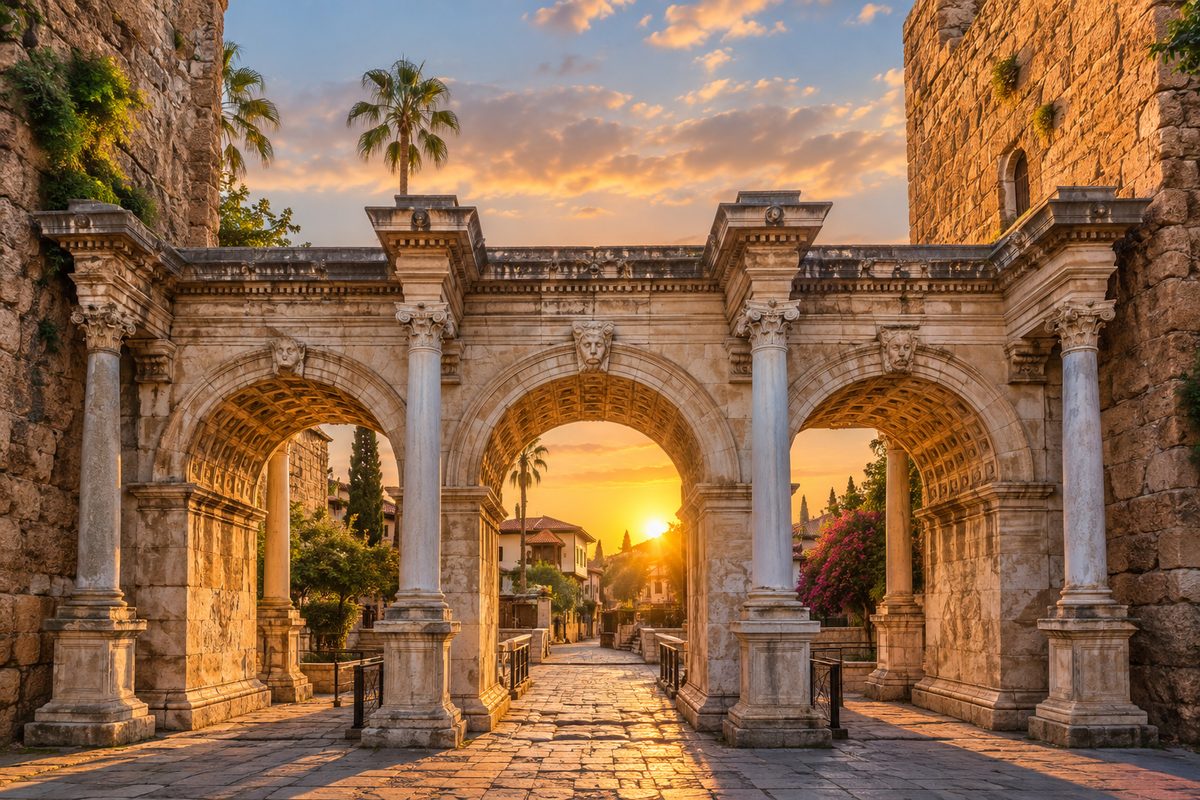
The gate has three arched openings, which explains its Turkish name, Üç Kapılar. It was constructed almost entirely from white marble apart from its columns, and its carved decoration remains one of its most impressive features. The original monument was taller than what survives today; its second storey has disappeared.
One of the most interesting parts of its story is how it survived.
As Antalya developed, later city walls were built around the monument. During the Byzantine period the gate was closed for defensive reasons, with walls constructed in front of and behind it. It eventually became largely hidden from view.
The gate was rediscovered in 1882, when sections of the surrounding walls were removed. A major restoration followed much later, in 1959. So the often-repeated claim that Hadrian's Gate was "rediscovered in the 1950s" is incorrect: 1882 was the rediscovery; 1959 was an important restoration date.
Why is Hadrian's Gate worth visiting?
Hadrian's Gate is one of those Antalya sights that takes very little time but gives you an immediate sense of the city's history.
The real attraction is the combination of Roman architecture, Kaleiçi and the Mediterranean. You can stand beneath a nearly 1,900-year-old monument and, within minutes, be walking through narrow historic streets toward the old harbour.
The gate is also unusually accessible. There is no museum entrance or lengthy visit required: it stands directly on the street and forms part of the everyday urban landscape of Antalya.
If you're exploring Kaleiçi for the first time, it's one of the most natural places to begin.
Top things to notice
1. The three arches
The three large marble arches are the defining feature of the monument.
Don't just photograph the front. Walk underneath the gate and look upward. The decorated ceilings and carved details are much easier to appreciate from inside the passage.
The gate's decoration includes intricate architectural carving and relief work, while the surviving marble gives the structure its distinctive appearance.
2. The towers on either side
Two towers stand beside the gateway, but they don't tell exactly the same historical story.
The southern tower is associated with the Roman period, while the northern tower incorporates an ancient base with a later Seljuk upper section. This makes the area around the gate a useful reminder that Antalya's history didn't stop with Rome — Roman, Byzantine and Seljuk layers remain visible within the same small area.
3. Walk straight into Kaleiçi
After looking at the gate, walk through it into Kaleiçi.
This is where the visit becomes more interesting. The modern boulevard suddenly gives way to narrow streets, historic houses, small hotels, restaurants and shops.
From here, continue downhill toward the old harbour. You can easily combine Hadrian's Gate with the marina, Hıdırlık Tower and several of Kaleiçi's historic buildings in one walk.
4. Look beyond the obvious photo
Most visitors stop on the boulevard and take the standard frontal photograph.
Instead, spend a few minutes looking at the monument from different angles. The interior of the arches, the columns and the surrounding towers give you much better views of the architectural details.
Late afternoon is particularly pleasant because the light becomes softer and the heat is usually less intense.
5. Remember what is missing
The Hadrian's Gate you see today is impressive, but it is not the complete Roman monument.
The original structure had a second storey, which has not survived. What remains is essentially the lower monumental gateway, with its three arches, columns and surviving decorative elements.
A simple Kaleiçi walking route
Hadrian's Gate works particularly well as the beginning of a walking route rather than as a stand-alone attraction.
Start: Hadrian's Gate
↓
Kaleiçi streets: Wander through the historic centre
↓
Tekeli Mehmet Paşa Mosque: One of the historic Ottoman-era landmarks in the area
↓
Old Harbour: Continue downhill toward the marina
↓
Hıdırlık Tower: Follow the waterfront and park area
↓
Karaalioğlu Park: Continue along the cliffs for Mediterranean views
↓
Return to Kaleiçi: Head back through the old streets
Allow around 2–3 hours for a relaxed version of this walk, longer if you stop for coffee, lunch or photographs.
The municipality's official Kaleiçi map also identifies several historic walking routes through the district, including Roman-Byzantine and Ottoman-Seljuk routes.
Visiting Hadrian's Gate: Practical Information
Location: Atatürk Caddesi, at the Kaleiçi entrance in central Antalya.
Cost: Free.
Opening: The monument is an open urban landmark rather than a ticketed museum, so there is no standard museum-style entrance procedure.
How long: Allow 20–30 minutes for the gate itself. Allow 2–3 hours if combining it with a Kaleiçi and harbour walk.
Best time: Early morning or late afternoon/evening, particularly during the hotter months. The historic centre can be very warm in the middle of the day.
Accessibility: The surrounding modern streets are substantially easier to navigate than the historic passage itself. The ancient stone surfaces and threshold can be uneven, so visitors with mobility limitations should take care when passing through the gate.
How to get to Hadrian's Gate
Hadrian's Gate is in central Antalya and is easily reached from other parts of the city.
The easiest option for many visitors is to travel toward central Antalya and continue on foot into Kaleiçi. The historic centre is also served by public transport, while taxis are readily available.
Because tram routes and airport connections can change, it is better to check the current Antalya public-transport network before travelling rather than relying on fixed journey times published online.
If you're arriving from Antalya Airport, allow extra time for traffic and connections, particularly during the busy summer season.
What to see nearby
Kaleiçi
You are already there. Antalya's historic centre contains layers of Roman, Byzantine, Seljuk and Ottoman history, along with restored historic houses, restaurants, cafés and the old harbour.
Roman Harbour
Continue downhill through Kaleiçi and you'll reach the historic harbour, now a marina surrounded by restaurants and cafés.
Hıdırlık Tower
One of Kaleiçi's most recognizable Roman-era structures, Hıdırlık Tower sits near the cliffs overlooking the Mediterranean.
Kesik Minare
The Broken Minaret is another example of Antalya's layered history, with a site that has passed through Roman, Byzantine and later periods.
Antalya Museum
If Hadrian's Gate makes you curious about the Roman world around Antalya, the Antalya Museum is the place to continue. Its collections cover the ancient civilizations of the region, including important material from the Roman period and archaeological sites such as Perge.
Important: The current Turkish Museums listing states that the Antalya Museum is presently closed to visitors, so check its official status before making it part of your itinerary.
Hadrian's Gate FAQ
What is Hadrian's Gate in Antalya?
Hadrian's Gate is a monumental Roman gateway built in AD 130 in honour of Emperor Hadrian's visit to Attaleia, the ancient city that became Antalya. It is also known in Turkish as Üç Kapılar, or Three Gates.
Is Hadrian's Gate free to visit?
Yes. Hadrian's Gate is an open public monument rather than a ticketed museum attraction.
How old is Hadrian's Gate?
It was built in AD 130, making it approximately 1,900 years old.
Why is Hadrian's Gate so well preserved?
The gate was later enclosed by city walls and effectively hidden from view. It was rediscovered when surrounding walls were removed in 1882. A major restoration followed in 1959.
How do I get to Hadrian's Gate?
The gate is on Atatürk Caddesi at the entrance to Kaleiçi in central Antalya. It can be reached by public transport or taxi, followed by a short walk.
How much time do you need at Hadrian's Gate?
Around 20–30 minutes is enough to see the monument properly. However, it makes more sense to combine it with Kaleiçi, the old harbour and the waterfront, for a 2–3 hour walk.
What else is near Hadrian's Gate?
Kaleiçi, the old harbour, Hıdırlık Tower, Kesik Minare and several historic mosques and buildings are all within walking distance.
Planning a Turkey trip?
Hadrian's Gate is one of those places that works best as part of a larger city itinerary. If Antalya is one stop on a longer Turkey trip, continue with our Istanbul guides for ideas on where to stay and what to explore in neighborhoods such as Moda and Kadıköy.
Bottom line: Don't make a special half-day trip just to see Hadrian's Gate. Instead, use it as your starting point for exploring Kaleiçi. See the Roman monument, walk through the old streets, continue down to the harbour, and finish along the Mediterranean cliffs. That's when the history of the gate really starts to make sense.
Ready to experience this?
Join Smileys and become part of the most vibrant social community in your city.